A pawn up with only kings beside it looks like a certain win. On the a file or the h file it often is not.
The reason is geography. There is no file beyond the edge, so a king cannot go around that side. This page shows the corner defense, the strange case where your own king becomes the problem, and how to judge the race to the corner.
What the edge takes away
With a pawn in the middle, a king ahead of it can often step left or right and clear the queening square from one side or the other. A rook pawn offers only one side. If the enemy king can sit in the corner or just beside it, there is no way to push that king out.
The queening square a8 has only three neighbors: b8, a7 and b7. A defender who holds that small block of four squares controls everything your pawn needs. A well placed defender cannot be pushed out of it by patience alone.
This also changes how you plan. The usual targets described in the key squares do not carry over. For a rook pawn, the first thing to look for is not your own king. It is where the defending king can go.
The king in the corner
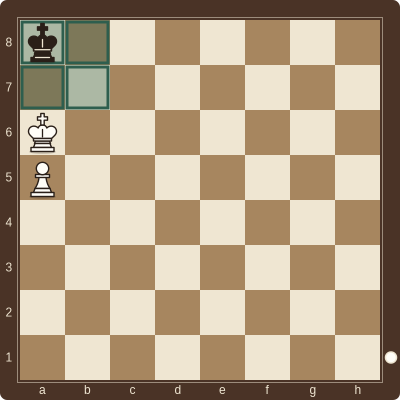
k7/8/K7/P7/8/8/8/8 w - - 0 1Watch the natural try: 1.Kb6 Kb8 2.a6 Ka8 3.a7. Black has no legal move and is not in check, so the game is drawn by stalemate. Stepping back with 1.Kb5 does not help either.
The defender does very little. It stays near the corner and steps back and forth. It does not even need to attack the pawn. Once the black king stands on a8, b8, a7 or b7, the position is drawn wherever the white king and pawn happen to be, as long as Black keeps playing correctly.
If you are unsure why this ends level and not as a mate, review checkmate versus stalemate.
Your own king in the way
The second drawing picture is the reverse. The attacking king is on the rook file, in front of its pawn, and the defending king keeps it boxed in from the c file.
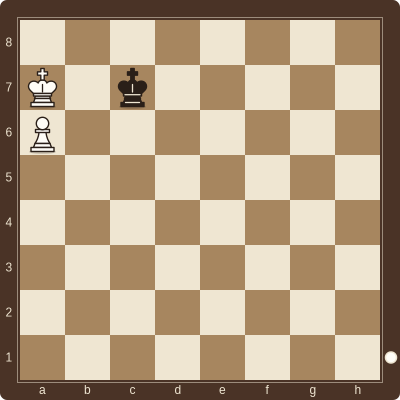
8/K1k5/P7/8/8/8/8/8 w - - 0 1After 1.Ka8 Kc8, pushing with 2.a7 Kc7 leaves White without a move: stalemate. Going back with 2.Ka7 Kc7 only repeats the picture. The black king simply alternates between c8 and c7.
Black still has to stay alert. If the black king drifts away with 1...Kd7, White plays 2.Kb7, covers a8 and escorts the pawn home. The defense works only while the king stays close enough to shut the door again.
The lesson for the attacker: do not walk into the corner ahead of your pawn if the enemy king can shadow you two files away. The pawn then becomes a wall behind your king instead of a threat.
The race to the corner
When the defending king starts further away, the question is whether it arrives before your king closes the door. Here one tempo decides.
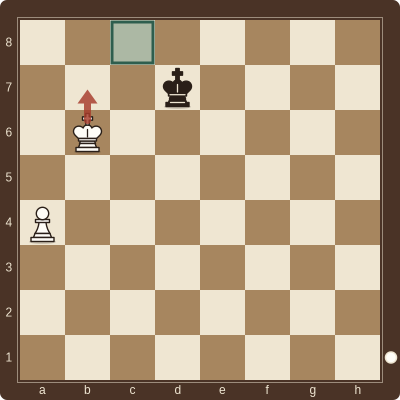
8/3k4/1K6/8/P7/8/8/8 w - - 0 1The winning move is 1.Kb7. It takes c8 away. Black cannot get back in time. One line runs 1...Kd6 2.a5 Kc5 3.a6 Kb5 4.a7, and the queen arrives. Pushing at once with 1.a5 allows 1...Kc8 and the draw.
Look at where the winning king ends up: on the b file, beside the corner, and not on the a file in front of its own pawn. From b7 it covers a8, b8 and c8 at once, which shuts every door the defender was heading for.
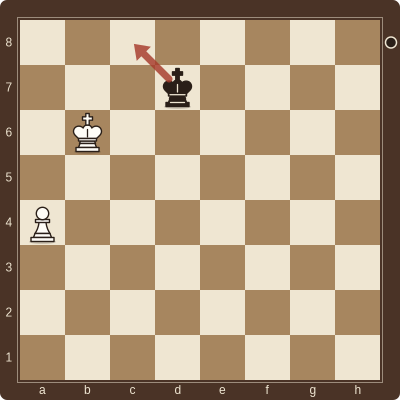
8/3k4/1K6/8/P7/8/8/8 b - - 0 1Same pieces, other side to move: 1...Kc8 reaches safety. After 2.a5 Kb8 3.a6 Ka8 4.a7 the game is stalemate. If a king needs to race, count its moves to the corner area and then check whether your king can block the way.
Count it on the race picture
Both sides want the same neighborhood.
- The black king on d7 is one move from c8.
- The white king on b6 is one move from b7, which covers c8.
- Whoever moves first gets there, so the side to move decides the game.
| Black king is on | Verdict | Watch for |
|---|---|---|
| a8, b8, a7 or b7 | Draw | Keep the king near the corner |
| c7 or c8 | Nearly always a draw | A pawn that has already reached a6 or a7 |
| Further away | Needs counting | Who reaches b7 or c8 first |
For the h pawn, mirror the squares: h8, g8, h7 and g7, while f7 and f8 play the part of c7 and c8. Before using the table, look for a simpler answer: the pawn may run alone with no king able to catch it. Check that first with the square of the pawn.
An extra bishop is not always enough
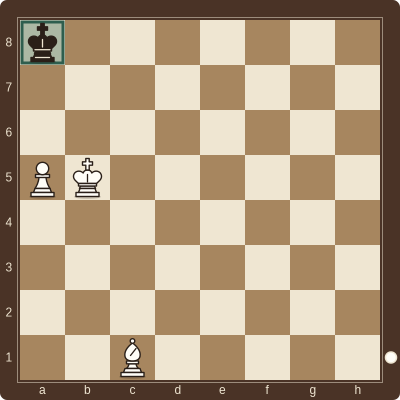
k7/8/8/PK6/8/8/8/2B5 w - - 0 1A bishop that cannot reach the corner square cannot drive the king out of it. This is the wrong bishop idea, a subject of its own. Remember only that before you swap down into a rook pawn ending with one bishop left, you should find the color of the queening square and compare it with the color your bishop moves on.
Common mistakes with rook pawns
- Trading into it without looking. A rook pawn ending that looks winning may be dead level.
- Pushing before blocking. Use your king to keep the other one away from the corner first.
- Leaving your king on the rook file. In front of the pawn, it can end up with nowhere to go.
- Defending far from the corner. As the defender, head for it at once and do not chase the enemy king.
Rook pawn quick check
Ask in this order.
- Can the pawn queen without any help?
- Can the defending king reach the corner area?
- Can my king take a square on that route away?
- Does my next pawn move leave a legal reply?
Compare these with the rules for other files in escorting a pawn with the king. Then set up the race position in the Board builder, switch the side to move and save both versions with a one line note.
Common questions
Is a king and rook pawn against a lone king always a draw?
No. The pawn side can win only when the defending king cannot reach the corner area, take the pawn or trap the attacking king in front of it. Against an a pawn, a king that gets to a8, b8, a7 or b7 holds the draw with correct play.
Which squares should the defender aim for against an a pawn?
Aim for a8, b8, a7 or b7. The squares c7 and c8 also hold in most positions.
Why is it stalemate and not checkmate in the corner?
The defending king is not attacked, yet every square next to it is covered or blocked. With no legal move and no check, the rules call it a draw.
Sources
- lila-tablebase: tablebase server based on Syzygy tables. Lichess open source project. Used to check the result of endgame positions with few pieces. Consulted on 25 November 2026.
- FIDE Laws of Chess taking effect from 1 January 2023. International Chess Federation (FIDE) Handbook. Rules of movement (Article 3), end of the game (Article 5), recording moves (Article 8), drawn positions (Article 9) and algebraic notation (Appendix C). Consulted on 25 November 2026.