You have a king and one pawn. Your opponent has only a king. The pawn wants to become a queen, but it cannot get there alone while the enemy king stands in the way.
The method is simple to say: send the king first, then the pawn. Here you will see why the order matters, which king squares win, and how to test the last pawn step before you play it. Everything applies to pawns on the b to g files. The a and h pawns follow their own logic.
Why pushing the pawn first lets the draw in
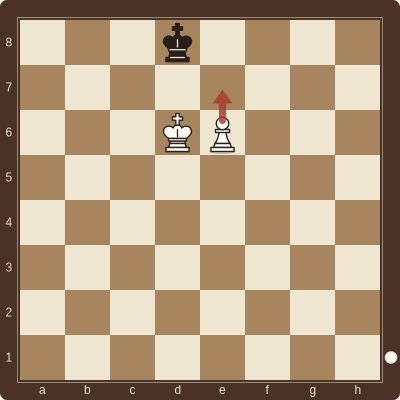
In the starting picture below, White has the move and a full pawn extra. It looks natural to run forward. It is also the quickest way to waste the win.
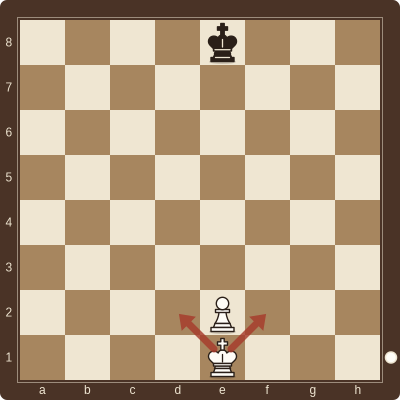
4k3/8/8/8/8/8/4P3/4K3 w - - 0 1After 1.e4 Ke7 2.Kd2 Ke6 3.Ke3 Ke5 the black king has walked up and stopped the pawn from the front. Your king is stuck behind its own pawn and has no way to push the defender aside. The position is a draw.
Now try the king first: 1.Kd2 Ke7 2.Ke3 Ke6 3.Ke4. The white king has taken the space in front of the pawn. Black has to give ground, and the pawn follows safely behind. The pawn has not moved at all, and that is the point: you can still use its step later, when you need to hand the move to Black.
The order matters because a pawn can never step back. Once it has run ahead, the squares it left behind are of no use to it, and your king has to work from further away. A king can change its mind. It can step left, right or back until the road is clear.
Get the king two squares ahead
While the pawn is still on the second, third or fourth rank, aim to place your king two ranks above it. From there it controls the road the pawn needs.
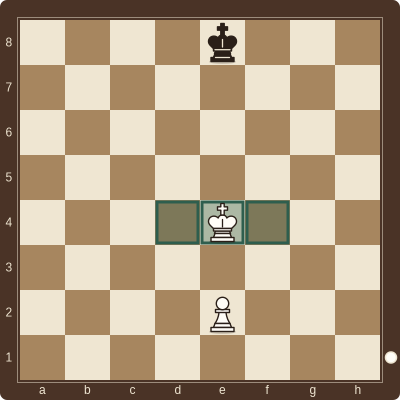
4k3/8/8/8/4K3/8/4P3/8 w - - 0 1The same is true with the king one file to either side, on d4 or f4 here. The only condition is that the defender cannot capture the pawn right away. These squares have a name, and the key squares of a pawn are the quickest way to judge a position without calculating it.
A king only one square ahead is a different case. Below the sixth rank, the result then depends on whose turn it is and where the black king stands. That duel is the opposition.
A king on the sixth rank decides it
Bring your king to the sixth rank in front of a pawn on the fourth or fifth rank, and, as long as the pawn is safe, you no longer need to ask whose turn it is.
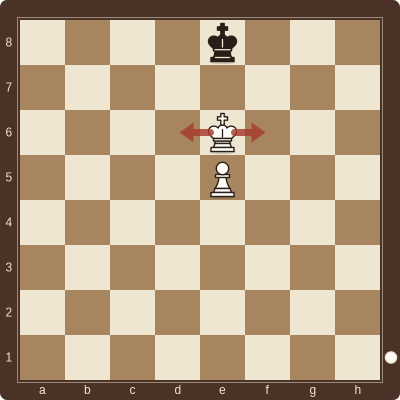
4k3/8/4K3/4P3/8/8/8/8 w - - 0 1Follow 1.Kd6 Kd8 2.e6 Ke8 3.e7 Kf7 4.Kd7. First the king steps to one side. Then the pawn advances while the black king is busy. At the end the white king guards e8, and the pawn queens. If Black had the first move in the diagram, the result would be the same.
With Black to move there, the black king can only go to d8 or f8. Your king can then step to the side away from it and escort the pawn in the same way. Do not memorize the squares. Remember the habit: step away from the defender, then advance.
Once you have a new queen, you still have to finish. See checkmate with king and queen for a safe method.
The seventh rank test: check or no check
Before the pawn steps to the seventh rank, ask one question: will it give check? With your king still on the sixth rank or lower, a check means draw. A quiet arrival, with your king protecting the pawn, usually means win.
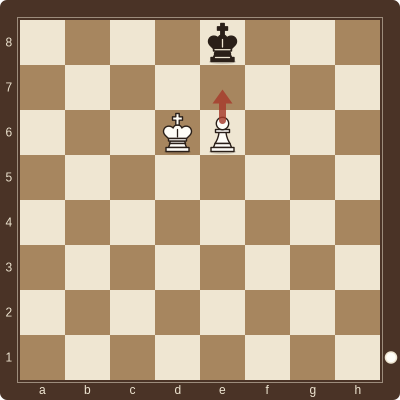
4k3/8/3KP3/8/8/8/8/8 w - - 0 1After 1.e7 the black king has just one move, 1...Kf7. Then 2.Kd7 protects the queening square, and nothing can stop the pawn.
3k4/8/3KP3/8/8/8/8/8 w - - 0 1Here 1.e7+ Ke8 leaves White with a bad choice. Moving away loses the pawn, while 2.Ke6 is stalemate.
There is one trap on the quiet side of the test. It concerns the c and f pawns with the black king in the corner.
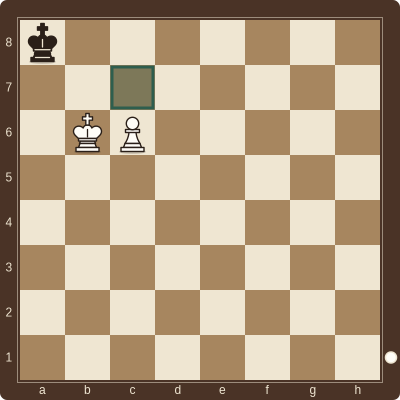
k7/8/1KP5/8/8/8/8/8 w - - 0 1If you push to c7, Black has no legal move and the game ends level. Look for stalemate before every seventh rank push.
Where the defending king should stand
When you defend, keep your king in front of the pawn and close to it. Meet the enemy king so that it cannot get beside or beyond the pawn. When you are forced back, the direction of the retreat matters.
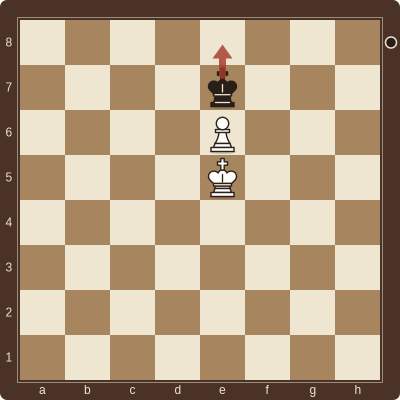
8/4k3/4P3/4K3/8/8/8/8 b - - 0 1After 1...Ke8 2.Kd6 Kd8 3.e7+ Ke8 4.Ke6 the game ends in stalemate. The black king went straight back, then faced the white king when it advanced. The two other retreats lose.
| What you see | Usual verdict |
|---|---|
| King two ranks ahead, on the pawn's file or the next, pawn on ranks 2 to 4 | Win, if the pawn cannot be captured at once |
| King on the sixth, same or next file, pawn on rank 4 or 5 | Win, if the pawn cannot be captured at once |
| King one square ahead, below the sixth | Depends on the turn and the black king |
| Pawn reaches rank 7 with check, king on rank 6 or lower | Draw |
| Pawn reaches rank 7 without check, protected | Win, except the corner stalemate with a c or f pawn |
Common mistakes with king and pawn
- Pushing because you can. Every pawn step you take early is one you cannot use later to give the move away.
- Walking behind the pawn. A king that follows its pawn cannot clear squares for it. Go around and get in front.
- Checking on the seventh by habit. A check feels strong. Here it often leads straight to stalemate.
- Forgetting the file. An a or h pawn does not obey these results. Read why a rook pawn so often draws.
Before you touch the pawn
Run through these in order.
- Can my king move forward instead?
- Can the black king capture the pawn?
- Would the next pawn move give check on the seventh?
- Would it leave Black with no legal move?
To practice, set up the first diagram in the Board builder, choose which side is to move and play it out against a friend. Copy the FEN of each position that surprised you and save it with a one line note. The builder has no analysis engine, so compare your result with the table above.
Common questions
Should I push the pawn or move the king first?
Move the king first in most cases. Get it ahead of the pawn, then advance the pawn when it cannot be stopped or when you need to pass the move.
Why is it a draw when the pawn gives check on the seventh rank?
With your king on the sixth rank or lower, the defender steps in front of the pawn. Your king then has to leave the pawn unprotected, or keep guarding it and give stalemate.
Does it matter whose move it is?
Often yes. With your king two ranks ahead of an early pawn, or on the sixth ahead of an advanced one, it no longer does, as long as the pawn is safe.
Sources
- lila-tablebase: tablebase server based on Syzygy tables. Lichess open source project. Used to check the result of endgame positions with few pieces. Consulted on 25 November 2026.
- FIDE Laws of Chess taking effect from 1 January 2023. International Chess Federation (FIDE) Handbook. Rules of movement (Article 3), end of the game (Article 5), recording moves (Article 8), drawn positions (Article 9) and algebraic notation (Appendix C). Consulted on 25 November 2026.