A passed pawn is sprinting and only the enemy king can stop it. You could count every move. There is a faster way.
Draw one square on the board and look where the king stands. You will learn to build it, to take the turn into account, to handle a pawn still on its starting rank and to notice the obstacles that break the rule.
How to draw the square
Take the pawn's square as one corner. Draw a line along its rank toward the enemy king and another up to the last rank. Both sides of the square are equally long: they match the pawn's road, from the square it stands on to the queening square.
There is a quick shortcut. Run a diagonal from the pawn toward the enemy king until it reaches the last rank. That end point is the far corner. If the diagonal runs off the side of the board, the square simply stops at that edge. If you are unsure about files and ranks, practice naming every square first.
Why does a square do the job? A king moves one step in any direction, so a diagonal step covers one file and one rank together. The number of moves it needs to reach the queening square is the larger of the two gaps, files or ranks. All squares within a given reach of the queening square form a square shaped block, and the half facing the king is the one you draw.
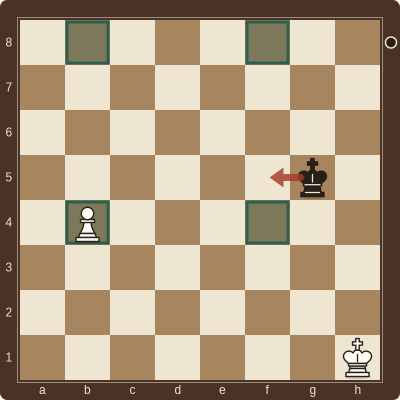
8/8/8/6k1/1P6/8/8/7K b - - 0 1The black king on g5 is just outside the b4 square. It is Black's turn, so it can step to the f file. After 1...Kf5 2.b5 Ke6 3.b6 Kd7 4.b7 Kc7 5.b8=Q+ Kxb8 the new queen is captured at once.
Count it on the first picture
The numbers behind the shape.
- The pawn on b4 needs four moves to queen on b8.
- The king on g5 is five files and three ranks from b8, so it needs five moves.
- With Black to move, it gets five turns, the last one to capture the queen.
- With White to move, it gets only four.
| Pawn on rank | Moves to queen | Side of the square |
|---|---|---|
| 2 | 5 | 6 squares |
| 3 | 5 | 6 squares |
| 4 | 4 | 5 squares |
| 5 | 3 | 4 squares |
| 6 | 2 | 3 squares |
| 7 | 1 | 2 squares |
Whose turn it is changes the answer
The rule depends on one fact. If the king is to move, it only needs to be able to step into the square. If the pawn is to move, push it first, redraw, and check whether the king can step into the new square.
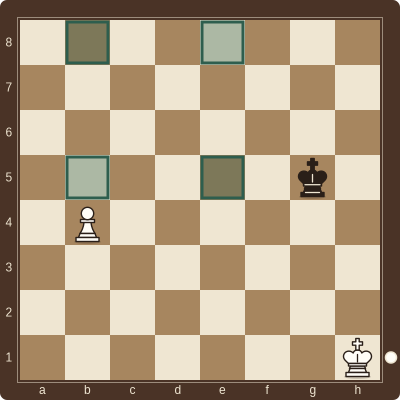
8/8/8/6k1/1P6/8/8/7K w - - 0 1After 1.b5 the new square ends on the e file. The black king can get no closer than the f file, which is outside. The line 1...Kf6 2.b6 Ke7 3.b7 Kd7 4.b8=Q shows it arriving one step late.
Once the pawn is past its starting rank, every push shrinks the square. A king that is chasing has to step into the new one every time.
Try it with an f5 pawn and the enemy king coming from the queenside. The pawn needs three moves, so its square runs from the f file across to the c file. If it is Black's turn, a king anywhere on the b file from the fourth rank upward can step in. A king on the b file but lower than that cannot.
The same rule serves the other side. If you are the one with the runner, look for the move order that leaves the king outside. Sometimes a single push now, instead of a quiet move, is all it takes.
The pawn on its starting rank
A pawn on its second rank may jump two squares. So draw the square as if it already stood on the third rank. Drawing it from the second rank gives the king a false hope.
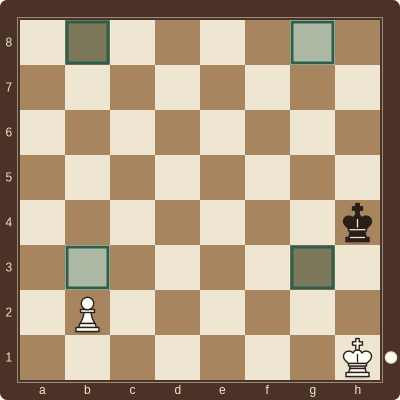
8/8/8/8/7k/8/1P6/7K w - - 0 1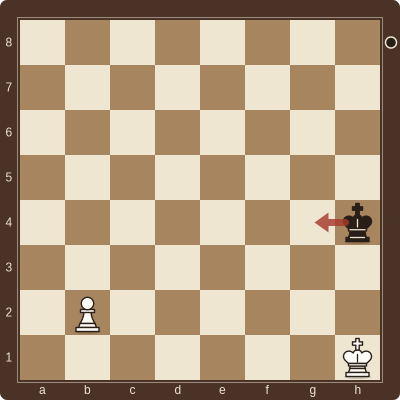
8/8/8/8/7k/8/1P6/7K b - - 0 1In the second picture, the square for the pawn reaches the g file. The king on h4 is outside, but it is Black's turn, so 1...Kg4 is enough. In the first picture White moves first with 1.b4, and the h file is too far.
The same idea holds for a black pawn still on rank 7: draw its square from rank 6. Whichever color runs, ask first whether the double step is still available.
Obstacles in the king's path
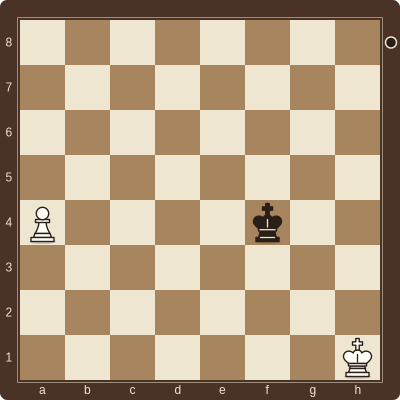
The square assumes the king can walk freely. Pieces of either color can spoil that. A square that an enemy piece attacks is closed to the king, and so is a square filled by one of its own pieces. Compare these two pictures, both with Black to move.
8/8/8/8/P4k2/8/8/7K b - - 0 1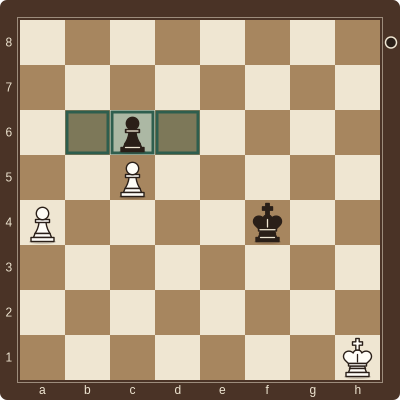
8/8/2p5/2P5/P4k2/8/8/7K b - - 0 1In both pictures the king can step into the a4 square. In the second, the squares b6 and d6 are covered by the c5 pawn, and c6 is filled by Black's own pawn. Every road short enough is shut. One line goes 1...Ke5 2.a5 Kd5 3.a6 Kxc5 4.a7 Kd6 5.a8=Q.
One blocked square is often harmless, because a king usually has several routes of the same length. Trouble starts when every one of them runs into something. After drawing the square, trace the actual path with your eyes before you trust it.
Common mistakes with the square
- Drawing from the second rank. Use the third rank for a pawn that has not moved.
- Ignoring the turn. Move the pawn first if it is the pawn's side to play.
- Counting a blocked road as open. Look for squares the king may not enter.
- Forgetting the other king. The rule is about a lone runner. If a king is helping the pawn, you need key squares instead.
Five second check
Use this when you see a passer.
- Count the moves to queen.
- Draw the diagonal to the last rank.
- Check whose turn it is.
- Look for anything in the king's way.
If both sides have a runner, the square is only the start and you will want to count pawn races. A distant passer also works as a decoy, as explained in the outside passed pawn.
Train your eye by placing a pawn and a king in the Board builder, deciding the answer in your head, then playing the moves out by hand.
Common questions
What is the square of the pawn?
It is an imagined square from the pawn to the last rank. A king that is inside it, or can step into it on its turn, catches a lone pawn.
How do I use the rule if the pawn is still on its second rank?
Draw the square from the third rank, because the pawn can advance two squares on its first move.
Does the square rule always work?
It works for a lone pawn when nothing blocks the king. Other pieces, covered squares or a helping king can change the result.
Sources
- FIDE Laws of Chess taking effect from 1 January 2023. International Chess Federation (FIDE) Handbook. Rules of movement (Article 3), end of the game (Article 5), recording moves (Article 8), drawn positions (Article 9) and algebraic notation (Appendix C). Consulted on 25 November 2026.
- lila-tablebase: tablebase server based on Syzygy tables. Lichess open source project. Used to check the result of endgame positions with few pieces. Consulted on 25 November 2026.