Both sides have a runner and neither king can stop it. This is a race, and the winner is not always the one who promotes first.
Here you will learn a simple counting method, then three details that decide what happens after the first new queen appears: a check, a line that guards the other pawn and a skewer.
A counting method you can trust
- Count how many moves your pawn needs to queen. A pawn on its second rank can jump two squares, so count the shorter road.
- Count the same for the other pawn.
- Note whose turn it is.
- Check whether any king can still interfere, and whether a pawn is blocked.
Turns alternate, so the side to move gets there first when the numbers are equal. If you are to move and need no more moves than your opponent, you queen first. If you need more, your opponent does.
| Side to move | W is less than B | W equals B | W is more than B |
|---|---|---|---|
| White | White first | White first | Black first |
| Black | White first | Black first | Black first |
Count two pawns
Say your pawn still stands on b2 and theirs on g4.
- Your pawn can jump to b4, then needs b5, b6, b7 and b8: five moves.
- Their pawn needs g3, g2 and g1: three moves.
- Unless something stops it, theirs queens first, whoever starts.
Do the count before your first push, not halfway through. Pawns cannot step back, and once both are running a single wasted turn can hand the race to the other side.
That only tells you who promotes first. It does not yet tell you who wins. For that you have to look at the board after the first queen arrives, and sometimes one move further. If you only need to know whether a lone king can catch a runner, use the square of the pawn instead.
Whoever moves first: the guarding queen
Here each pawn needs three moves. The a pawn goes to a8 and the h pawn to h1.
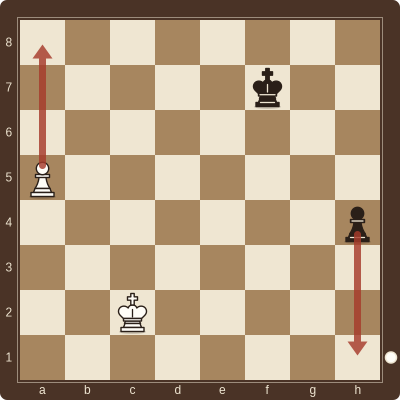
8/5k2/8/P7/7p/8/2K5/8 w - - 0 1After 1.a6 h3 2.a7 h2 3.a8=Q the new queen looks down the long diagonal straight to h1. If Black promotes anyway, 3...h1=Q 4.Qxh1 takes the new queen.
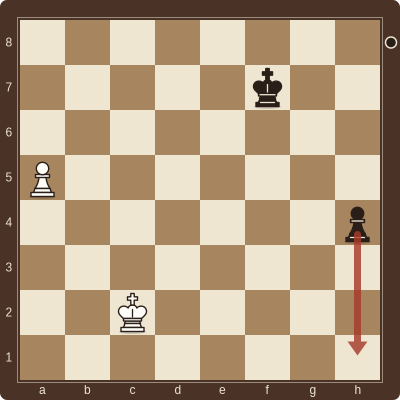
8/5k2/8/P7/7p/8/2K5/8 b - - 0 1This time 1...h3 2.a6 h2 3.a7 h1=Q 4.a8=Q Qxa8 uses the same diagonal in the other direction. One tempo switched the winner.
So before you push, picture your queen on its queening square and ask which squares it will control. A queen that watches the other promotion square often ends the race on the spot.
From a8 a queen sees the rest of the a file, the whole eighth rank and the long diagonal down to h1, as long as nothing stands in between. A pawn that promotes on any of those squares walks into the queen's line.
Queening with check
If your new queen gives check, your opponent has to answer it first. Their pawn usually stands still for that turn, and your queen gets a chance to deal with it.
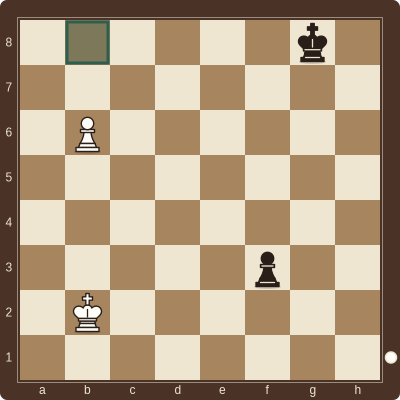
6k1/8/1P6/8/8/5p2/1K6/8 w - - 0 1Play 1.b7 f2 2.b8=Q+. Black has three king moves, and in each case the queen reaches the pawn. After 2...Kf7 3.Qf4+ Ke7 4.Qxf2 the race is over. The other two answers run 2...Kg7 3.Qf4 Kg6 4.Qxf2 and 2...Kh7 3.Qh2+ Kg6 4.Qxf2.
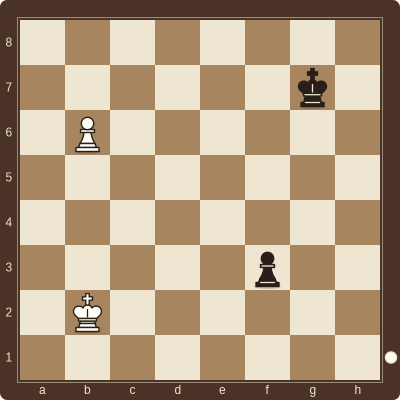
8/6k1/1P6/8/8/5p2/1K6/8 w - - 0 1Here 1.b7 f2 2.b8=Q gives no check, Black plays 2...f1=Q, and both sides own a queen. The only change is where the king stood. When you count a race, note whether either king is standing on a rank, file or diagonal that a new queen will use.
The skewer after promotion
Sometimes the second queen to appear is the stronger one, because the first is lined up with its own king.
A skewer is an attack on two pieces on one line, where the front one must move and leaves the back one to be taken. In a race, the enemy king is often the front piece and the freshly made queen is the one behind.
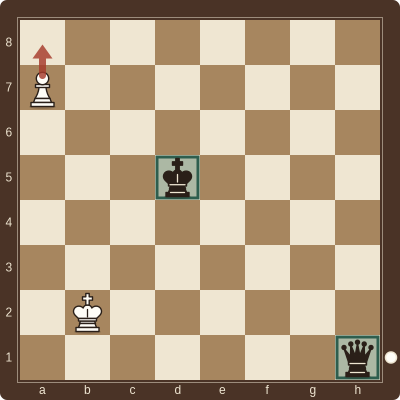
8/P7/8/3k4/8/8/1K6/7q w - - 0 2The move 1.a8=Q+ sends the check along the diagonal through d5. The king must step off it, and behind it stands the queen on h1. After 1...Kd4 2.Qxh1 White has a queen and Black has none. Every other king move meets the same capture. That is a skewer.
To find it, look at your own queening square first. Run your eye along each line that leaves it. If the enemy king is on one of them, ask what stands further along the same line, now or after the next pawn move.
Once you are a queen ahead, finish calmly with the method in checkmate with king and queen.
Try the same search on the first race of this page. After 3.a8=Q there is no check on the king at f7. The queen does watch h1, which is the point that matters. No skewer is needed, because the new black queen would simply be captured.
At the end of every race
Picture the position after the first promotion.
- Does the new queen give check?
- Does it control the other queening square?
- Are a king and a new queen on one line, ready for a skewer?
- Can the other pawn still advance, or has a king stepped in its way?
Common mistakes in pawn races
- Stopping at the count. Queening first can still lose to a skewer.
- Forgetting the double step. A pawn on its starting rank may be a move faster than it looks.
- Ignoring the kings. A king may block a square or a diagonal, or stand where a new queen checks it.
- Pushing without checking the other side. Count their pawn before yours.
A runner far from the other pawns can be used in a different way, as a lure: see the outside passed pawn. To practice races, place the pieces in the Board builder, write your verdict in the note, then play it through move by move.
Common questions
Who queens first in a pawn race?
Count the moves each pawn needs. The side to move arrives first when the counts are equal, and otherwise the shorter count wins the race to promote.
Why does queening with check matter so much?
A check must be answered at once, so your opponent usually cannot use that turn to push their pawn. Your queen often gets time to stop it.
Does queening first guarantee a win?
No. Both sides may end up with a queen, or the first queen may be skewered or captured. Look at the position after promotion.
Sources
- FIDE Laws of Chess taking effect from 1 January 2023. International Chess Federation (FIDE) Handbook. Rules of movement (Article 3), end of the game (Article 5), recording moves (Article 8), drawn positions (Article 9) and algebraic notation (Appendix C). Consulted on 25 November 2026.
- lila-tablebase: tablebase server based on Syzygy tables. Lichess open source project. Used to check the result of endgame positions with few pieces. Consulted on 25 November 2026.