Three pawns face three pawns and nothing seems able to move forward. Yet one side can give up two pawns and send the third through.
You will learn the standard shape, the exact order of moves, the answer to each reply and the two conditions that decide whether it works: who moves first and how far away the enemy king is.
The standard shape
Look for three pawns side by side on your fifth rank, facing three enemy pawns on their second rank. Your pawns are close to promotion. Theirs are still at home. The enemy king is too far to help.
The idea behind it is simple. Each of your pawns is held back by an enemy pawn on its own file or the one beside it. If you can drag those guards to the wrong squares, one of your pawns will have an empty road. Two offers are enough to do it.
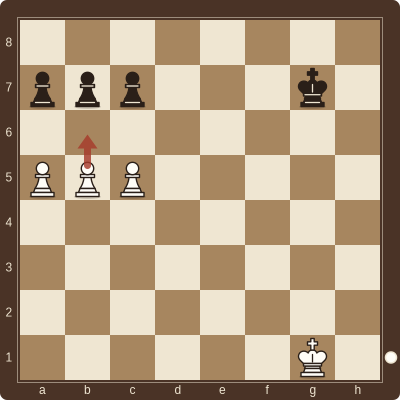
8/ppp3k1/8/PPP5/8/8/8/6K1 w - - 0 1The first move is the middle pawn. It attacks both a7 and c7, so Black has to deal with it at once. If Black ignores it, the b pawn captures on a7 or c7 and runs on to queen.
A flank push first is no substitute. Both 1.a6 bxa6 and 1.c6 bxc6 turn the game around, and White is the side that ends up lost.
The move order, reply by reply
Black has two ways to capture on b6. Each is answered by pushing the pawn on the opposite side from the pawn that captured.
Here is why. After 1...axb6, the only black pawn that covers a6 is the one on b7. The push 2.c6 attacks it, and once it captures on c6, a6 is no longer covered. After 1...cxb6, the pawn on b7 is again the only guard, this time of c6, and 2.a6 drags it away.
| Black plays | White answers | Then |
|---|---|---|
| axb6 | c6 | After ...bxc6 push a6 |
| cxb6 | a6 | After ...bxa6 push c6 |
| a6 | bxc7 | The c pawn queens |
| c6 | bxa7 | The a pawn queens |
| A king move | bxa7 or bxc7 | A pawn queens |
Take 1...axb6 first. White answers 2.c6. After 2...bxc6 3.a6 the a pawn has a free path and queens first: 3...c5 4.a7 c4 5.a8=Q. The new queen then handles the black pawns.
The other branch mirrors it. After 1...cxb6 2.a6 bxa6 3.c6 the c pawn goes through: 3...a5 4.c7 a4 5.c8=Q.
Count the finish
Check the race once the road is open.
- After the third move your pawn needs two more steps to queen.
- Black's pawns are still on rank 6 or 7, so the quickest of them needs five steps.
- You queen with time to spare, so the new queen can turn around and stop them.
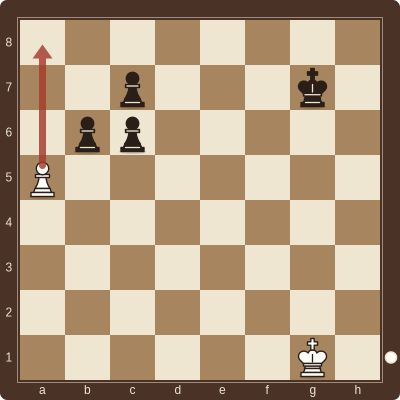
8/2p3k1/1pp5/P7/8/8/8/6K1 w - - 0 3If Black does not take the second offer, White takes the pawn on b7 instead. After 1...axb6 2.c6, a reply such as 2...b5, 2...bxa5 or a king move allows 3.cxb7 and the pawn queens. The same applies after 1...cxb6 2.a6, where 2...b5 or 2...bxc5 allows 3.axb7.
Push, do not recapture
The move that spoils it feels natural. After 1.b6 axb6, taking back with the a pawn looks tidy.
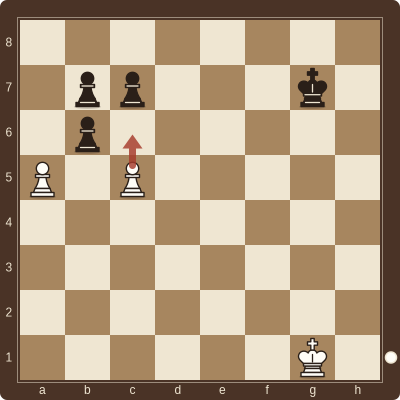
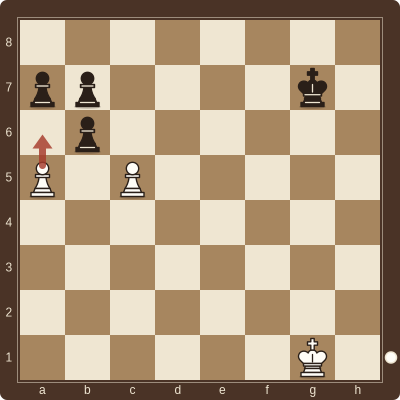
8/1pp3k1/1p6/P1P5/8/8/8/6K1 w - - 0 2If White plays 2.axb6, Black replies 2...c6 and White is the one who loses. The whole idea is to open a road, not to get the pawns back. Count files, not pawns. After the second offer you are two pawns down for a moment, and that is fine because the survivor cannot be caught. This is a form of deflection: each offer drags a guard away from the road you want.
8/pp4k1/1p6/P1P5/8/8/8/6K1 w - - 0 2If the defender moves first
Give Black the move in the starting position and the break can be stopped. The middle pawn does the job again: 1...b6. A king step to the f file also stops the immediate break, for the reason shown in the next section.
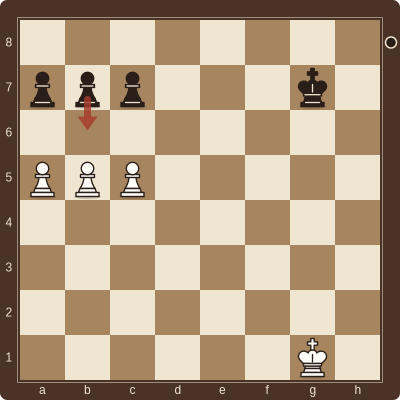
8/ppp3k1/8/PPP5/8/8/8/6K1 b - - 0 1After 1...b6, Black should recapture with the pawn on the same file that White's capturing pawn came from. If 2.cxb6 then 2...cxb6, and if 2.axb6 then 2...axb6. Both are level. The other recapture loses to a further push, 3.a6 in the first case and 3.c6 in the second. Pushing past with 2.a6 or 2.c6 is bad for White: Black captures on the other side and wins.
The flank moves fail for Black. Against 1...a6 White plays 2.c6, and against 1...c6 White plays 2.a6. Both break through.
Conditions on the kings
The surviving pawn is only decisive if the enemy king cannot get back to it. Move the black king from g7 to f6 and everything changes. The two queening squares to worry about are a8 and c8, and c8 is the one nearer to a king on the kingside.
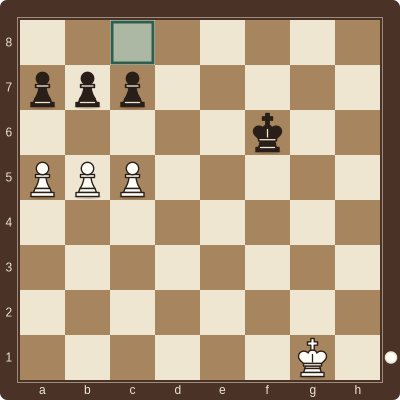
8/ppp5/5k2/PPP5/8/8/8/6K1 w - - 0 1Here 1.b6 cxb6 2.a6 bxa6 3.c6 Ke7 brings the king back in time, and Black's extra pawns win. Before breaking through, check each of the two possible survivors with the square of the pawn. Remember that Black chooses which capture to make, so both branches must work, not only the one you hope for.
Before you start the break
Look at all of these.
- Is it my turn?
- Can the enemy king reach the queening square of either survivor?
- Are my three pawns far enough advanced?
- If both sides will queen, who gets there first?
That last question belongs to pawn races. And if your runner sits far from the other pawns, you may prefer to use it as an outside passed pawn.
Common mistakes in the breakthrough
- Starting with a flank pawn. In the standard shape the middle pawn goes first, or the attack rebounds.
- Recapturing. After the first capture, push the far pawn instead.
- Not counting the king. One file closer can turn a win into a loss.
- Waiting a move too long. If the opponent can play the blocking move first, the chance is gone.
To drill it, set up the first diagram in the Board builder, play both captures from memory, then switch the side to move and find the blocking move. Save the position with a note naming the first move.
Common questions
Which pawn do I push first in a three against three breakthrough?
The middle one. It attacks two pawns at once and forces a reply.
Does the breakthrough work if it is the defender's turn?
Not in the standard shape if the defender plays the middle pawn forward one square and then recaptures correctly.
Why does the position of the king matter so much?
You give up two pawns to promote one. If the enemy king stops that one, you are simply pawns down.
Sources
- FIDE Laws of Chess taking effect from 1 January 2023. International Chess Federation (FIDE) Handbook. Rules of movement (Article 3), end of the game (Article 5), recording moves (Article 8), drawn positions (Article 9) and algebraic notation (Appendix C). Consulted on 25 November 2026.