Sometimes the winning move is right there, except that one enemy piece stands in the wrong place for you. Instead of waiting for it to move, you make it move.
Here you will learn what separates a deflection from a decoy, see each one carried out with a check and practice the step that matters most: working out what happens if the opponent says no.
Two ways to force a piece to move
A deflection pulls an enemy piece away from a job. It was protecting a piece or a square, and your move obliges it to leave that post. What you want is whatever it leaves behind.
A decoy drags an enemy piece onto a particular square where something bad is waiting: a fork, a skewer or a mate. Here you care about the square it arrives on, not the one it leaves.
Both often involve offering material. You place a piece where it can be taken, knowing that the capture does the opponent harm. Both also work best with checks, because a check narrows the list of replies.
A good way to find them is to start with a wish. If only that rook were not protected. If only the king stood on that square, my knight would fork it. Then look for a forcing move that makes the wish come true.
| Point | Deflection | Decoy |
|---|---|---|
| Goal | Pull a piece off its job | Drag a piece to a bad square |
| What you study | What the piece is guarding | What the new square allows |
| Follow-up | Take what was left behind | Fork, skewer or mate |
| Example below | Bg5+ forces the king away | Rh8+ pulls the king into a fork |
Deflection: the king leaves its post
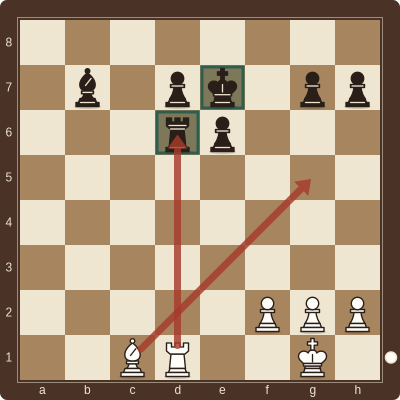
8/1b1pk1pp/3rp3/8/8/8/5PPP/2BR2K1 w - - 0 1Taking at once with Rxd6 only swaps rooks, because Kxd6 recaptures. The king is doing a job. Give it something more urgent to do.
Bg5+ checks along the diagonal. No black piece can block on f6 or capture on g5, so the king has to move. Its three squares are f8, e8 and f7, and none of them touches d6. After any of them, Rxd6 wins the whole rook.
Notice that nothing was offered here. A deflection is about the effect, not about the offer. If a check does the job without giving up material, so much the better.
Two features made it work. The rook on d6 had a single protector, and that protector was the king, which cannot ignore a check. Whenever a loose-looking piece leans only on the king, list your checks and see which of them push the king out of reach.
Decoy: the king steps into a fork
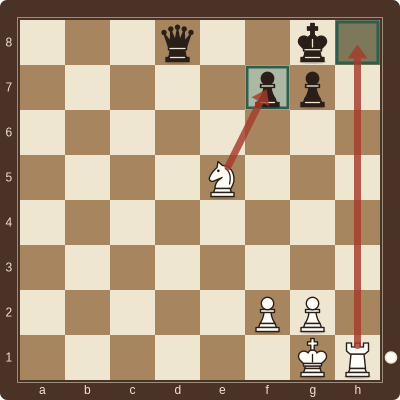
3q2k1/5pp1/8/4N3/8/8/5PP1/6KR w - - 0 1The knight would love to be on f7, but Nxf7 now simply loses it to Kxf7. The idea works only if the king stands somewhere else.
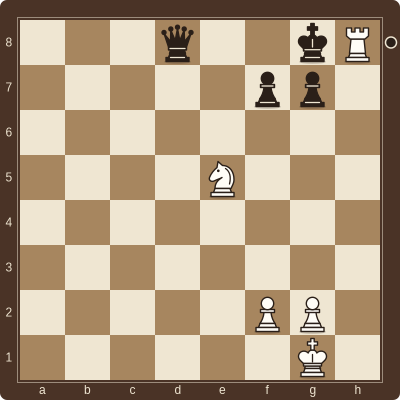
3q2kR/5pp1/8/4N3/8/8/5PP1/6K1 b - - 1 1Rh8+ leaves Black no choice: Kxh8 is forced. Now Nxf7+ checks the king in the corner and attacks the queen on d8. After the king steps out, Nxd8 collects her.
Add it up. White gave a rook for a queen and a pawn. The rook was not the point. The square h8 was, because from there the king can be forked.
To discover decoys yourself, look for a fork that is one square short. Here f7 would hit d8 and h8, so the question became how to bring the king to h8.
Why checks do the forcing
An offer without a check can often be ignored. The opponent has a whole turn and may use it to protect something or to start a threat of their own. A check removes that freedom: only moves that deal with the king are legal.
Checks are also the easiest moves to calculate. There are three kinds of answer: move the king, block the line or capture the checking piece. Write down every one that is legal. If the list has a single entry, as after the rook check on h8, you know exactly where the enemy pieces will stand when it is your turn again.
- Look at checks first, even ones that seem to lose a piece.
- Count the legal replies before you judge the move.
- Calculate the check with the fewest answers first.
- Then look at captures and mate threats as the next most forcing tools.
Patterns with offers are common near a king. In many back rank mates a defender is first pulled off the last rank, and in the classic smothered mate a queen offered on g8 draws a rook onto the square that boxes its own king in.
Calculating the refusal
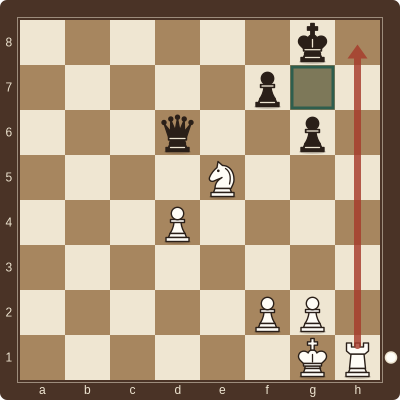
6k1/5p2/3q2p1/4N3/3P4/8/5PP1/6KR w - - 0 1With the pawn on g6, the square g7 is empty. After Rh8+ Black is not forced to take. Kg7 attacks the rook, so White has to rescue it, for example with Rh4. Nothing has been won.
If Black accepts with Kxh8, the fork still works: Nxf7+ and then Nxd6. But your opponent gets to choose, so judge the move by the best answer, not by the one you hope for.
Three small changes separate this from the decoy position: a pawn on g6 leaves g7 open, the queen on d6 is off the rook's line, and a new pawn on d4 guards your knight, which that queen now attacks. That is why a pattern you remember is only a suggestion. Each time, check the squares around the king again before you give up material.
Before you offer anything
- Can the king move instead of capturing?
- Can something block the check?
- Can a different piece make the capture and spoil your follow-up?
- If they decline, are you still no worse off?
- If they accept, is every follow-up still legal and safe?
Common deflection and decoy mistakes
- Calculating only the line where the opponent accepts.
- Forgetting that a second defender takes over the abandoned job.
- Offering without check and handing over a free turn.
- Pulling a piece onto a square where it becomes more active.
- Offering a larger piece when a smaller one would drag the target just as well.
These ideas sit next to two others. Removing the defender deals with the guard head on, and overloaded pieces are the easiest ones to deflect. Set up the three starting positions with the Board builder and play the refusals yourself.
Common questions
What is the difference between a deflection and a decoy?
A deflection takes a piece away from something it protects. A decoy brings a piece to a square where it can be exploited. One move can do both.
Do I always have to give up material?
No. A check or a threat can deflect a piece without offering anything. Offers are common because they make the opponent's reply more predictable.
How do I know the offer is correct?
List every legal reply, including the ones that decline. The offer is sound only if each of them leaves you at least as well off.
Can the king be deflected?
Yes. A check forces the king to move, and if it was protecting a piece, that piece may be left alone.
Sources
- FIDE Laws of Chess taking effect from 1 January 2023. International Chess Federation (FIDE) Handbook. Rules of movement (Article 3), end of the game (Article 5), recording moves (Article 8), drawn positions (Article 9) and algebraic notation (Appendix C). Consulted on 25 November 2026.