Every square on a chess board has a short name, such as e4 or c7. Once those names come to you quickly, you can follow written moves, copy a position from a page and tell a study partner exactly which square you mean.
You will learn how files and ranks are labeled, how to read a square from either side of the board, how to work out its color in your head and how to practice all of this in a few minutes.
Files run up the board, ranks run across
A file is a column of eight squares that runs from one player toward the other. Files carry the letters a to h. A rank is a row of eight squares that runs from side to side. Ranks carry the numbers 1 to 8.
Both are counted from White's seat. The a-file is on White's left and the h-file is on White's right. Rank 1 is the row nearest White, where the white pieces start. Rank 8 is the row nearest Black.
| Part | Labeled with | Where to find it |
|---|---|---|
| File | letters a to h | a on the left, h on the right |
| Rank | numbers 1 to 8 | 1 nearest, 8 farthest |
| Square | letter, then number | where one file crosses one rank |
The names belong to the board, not to the player. A square keeps its name when you walk round to the other side, when pieces come and go and when a screen view is turned.
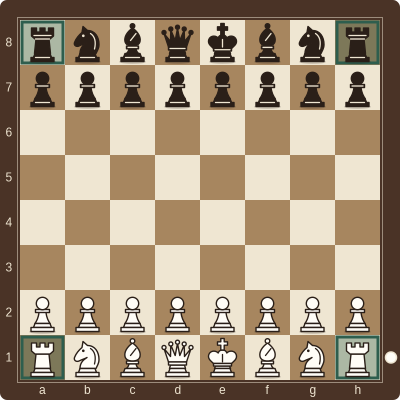
rnbqkbnr/pppppppp/8/8/8/8/PPPPPPPP/RNBQKBNR w KQkq - 0 1Read the letter first, then the number
A square name is the file letter followed by the rank number: e4, not 4e. The letter is written in lowercase. Uppercase letters have another job, naming the pieces in written moves, which you can study in algebraic notation for beginners.
To find a square, put one finger on its letter along the bottom edge and another on its number along the side. Slide the first finger up the file and the second across the rank. Where they meet is your square.
To name a square, work the other way. Look straight down from the square to read its letter, then straight to the side to read its number.
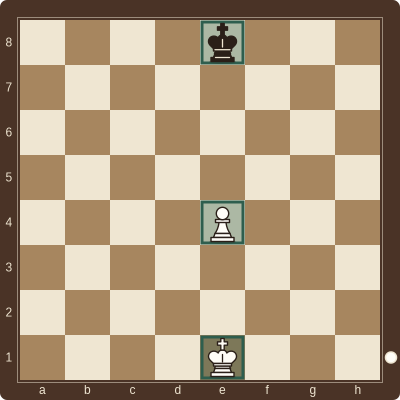
4k3/8/8/8/4P3/8/8/4K3 w - - 0 1Naming the three marked squares
Read each one from White's side, letter before number.
- The pawn is in the fifth column from the left and the fourth row from the bottom, so its square is e4.
- The white king is in the same column on the first row: e1.
- The black king is in the same column on the last row: e8.
Corners, colors and the light square on the right
A board is placed correctly when each player has a light square in the near right corner. For White that corner is h1. For Black it is a8. If a dark square sits there, give the board a quarter turn before you set up a single piece.
You can work out the color of a square without seeing it. Turn the file letter into a number (a is 1, b is 2, and so on up to h as 8) and add the rank number. An even total is a dark square. An odd total is a light square.
| Square | Sum | Color |
|---|---|---|
| a1 | 1 + 1 = 2 | dark |
| h1 | 8 + 1 = 9 | light |
| c5 | 3 + 5 = 8 | dark |
| e4 | 5 + 4 = 9 | light |
| g7 | 7 + 7 = 14 | dark |
Squares of the same color meet only at their corners, so each diagonal has a single color. A bishop therefore never leaves the color it starts on. A knight does the opposite: every knight move lands on the other color.
The two longest diagonals make good landmarks. The one from a1 to h8 is dark from end to end. The one from h1 to a8 is light.
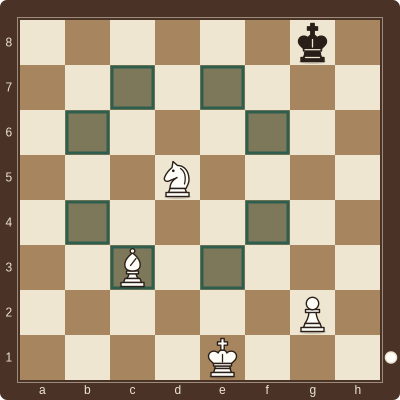
6k1/8/8/3N4/8/2B5/6P1/4K3 w - - 0 1Finding squares from the black side
When you sit behind the black pieces, nothing is renamed, yet everything seems turned around. The h-file is now on your left and the a-file on your right. Rank 8 is nearest you and rank 1 is at the far end. The letters run backwards from left to right, and the numbers grow as they come toward you.
A common trap is to treat your own near left corner as a1. It is h8. The square a1 is the dark corner at the far end, on your right.
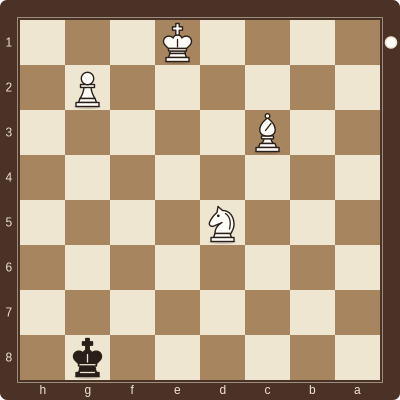
6k1/8/8/3N4/8/2B5/6P1/4K3 w - - 0 1Two habits help. First, find your anchor before looking for anything else: which rank is at the bottom and which letter is on the left. Second, count from the nearest edge. From Black's seat, ranks 8, 7 and 6 should become as familiar as ranks 1, 2 and 3 are for White.
It also helps to know which squares trade places on screen when a view is flipped: d4 with e5, c3 with f6, a1 with h8. Each pair is a half turn apart around the center. The same anchor check matters when you copy a printed diagram onto a real board.
Drills that build speed
Keep each practice short so that you can repeat it often. Start with single squares and a real board in front of you, then remove the edge labels from view by covering them with strips of paper.
A five-minute coordinate drill
- Name the four corners and their colors with your eyes closed.
- Pick a file and call its eight squares from rank 1 to rank 8, then back again.
- Pick a rank and call its squares from a to h, then from h to a.
- Say any square, work out its color with the sum, then check on the board.
- Walk round to Black's side and repeat the same calls.
- Point at a square and name it without counting along the edge.
Once single squares are easy, move on to lines and shapes. Call every square on the diagonal from c1 to h6, or the squares a knight can reach from g1. Endgame rules that speak about areas of the board, such as the square of the pawn, become much easier to apply when you no longer count with your finger.
You can practice with positions too. Place a few pieces in the Board builder, say their squares aloud, then flip the board and check that you still read them correctly.
Common mistakes with coordinates
- Number before letter. The file letter comes first in every square name.
- Counting from your own left as Black. From that seat your left edge is the h-file.
- Mixing up files and ranks. Files have letters and point toward the opponent. Ranks have numbers and run sideways.
- A turned board. With a dark square in the near right corner, the pieces end up on the wrong squares and the names no longer fit.
- Look-alike letters. When you write by hand, make your b and d clearly different.
One last test catches a badly placed board. In the starting position the white queen belongs on d1, a light square, and the black queen on d8, a dark square. Each queen begins on a square of her own color. If yours do not, check the corner squares and the order of the back rank.
Common questions
Is a1 on the left or the right for White?
It is on White's left, in the row nearest White. It is a dark square.
How can I tell if a square is light or dark?
Number the file from 1 to 8 and add the rank number. An even total is dark and an odd total is light.
Do square names change when I play Black?
No. You only see the board from the other end, so the a-file is on your right and rank 8 is nearest you.
Why do chess diagrams show letters and numbers on the edge?
They let you name a square without counting, and they show which side of the board is at the bottom.
Sources
- FIDE Laws of Chess taking effect from 1 January 2023. International Chess Federation (FIDE) Handbook. Rules of movement (Article 3), end of the game (Article 5), recording moves (Article 8), drawn positions (Article 9) and algebraic notation (Appendix C). Consulted on 25 November 2026.