A chess diagram is a flat picture of the board. Copying it to a real board sounds simple, yet one slip, such as a turned view or a mirrored side, gives you a different position with a different answer.
You will learn to find the orientation, use the edge letters and numbers, spot who is to move, place the pieces in an order that limits slips and check the result by counting.
Which side is at the bottom
The usual convention puts White at the bottom, so that white pawns move up the page and black pawns move down. Some diagrams are drawn from Black's side instead, so check before you touch a piece.
The edge labels settle it. If the files read a to h from left to right and rank 1 is at the bottom, you are looking from White's side. If they read h to a and rank 8 is at the bottom, you are looking from Black's side.
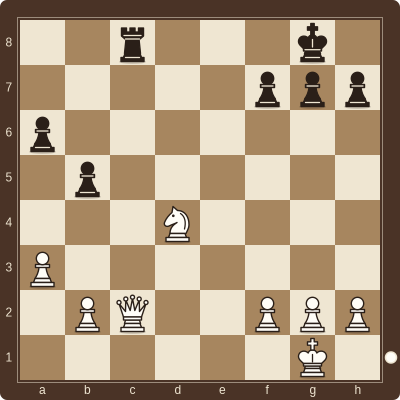
2r3k1/5ppp/p7/1p6/3N4/P7/1PQ2PPP/6K1 w - - 0 1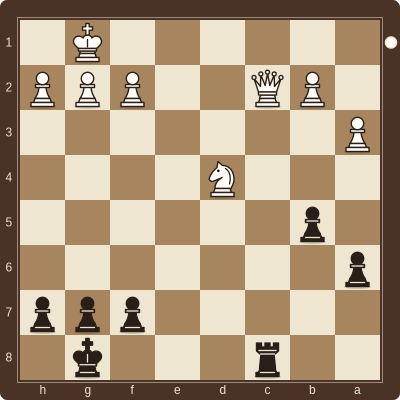
2r3k1/5ppp/p7/1p6/3N4/P7/1PQ2PPP/6K1 w - - 0 1Compare the two pictures. The white queen is on c2 in both, but in the second it appears near the top right. If a diagram has no labels and no caption, you can assume White is at the bottom, but remember that it is only an assumption.
Coordinates and the light corner
Prepare your own board first. Each player should have a light square in the near right corner. Then find a1, the dark corner on White's left. The naming system is explained in full in board coordinates.
Give each piece its square name before you place it. Read the letter under its column, then the number beside its row. Say the name, find that square on your board and set the piece down.
Working by names protects you from copying shapes by eye, where a piece easily lands one square off. It also works if you sit behind the black pieces while the diagram shows White's view. The square a1 is then at the far end, on your right.
Find out who is to move
A position without a side to move is only half a position. In the picture above, with White to move, the queen can capture the rook on c8. With Black to move, that same rook can capture the queen first.
| What you may see | What to understand |
|---|---|
| a caption saying White to move | White plays next |
| a caption saying Black to move | Black plays next |
| a light marker beside the board | usually White to move |
| a dark marker beside the board | usually Black to move |
| nothing at all | search the surrounding text before assuming |
The diagrams in these guides carry a small round dot to the right of the board, level with the side that moves: light for White and dark for Black. Marker styles differ between sources, so read any key that comes with them.
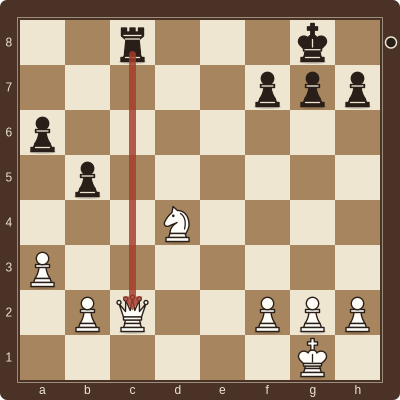
2r3k1/5ppp/p7/1p6/3N4/P7/1PQ2PPP/6K1 b - - 0 1Set up in an order that avoids errors
- Check the board: light square in each near right corner.
- Place both kings.
- Place the queens, then the rooks, bishops and knights.
- Place the pawns file by file, from a to h.
- Note who is to move, for example with a spare button beside that side.
Start with an empty board, so that no leftover piece from an earlier position slips into the new one.
Handling one piece type at a time means that you search the diagram for a single shape. The kings come first because each position has one for each side, which gives you two firm reference points.
Pawns come last. There are often many of them, and moving through the files in order makes a missed one easy to notice. Finish one color on a file before going to the next, or do all of White's pawns and then all of Black's. Pick one habit and keep it.
The order applied to the first diagram
Read these aloud as you place each one.
- Kings: White to g1, Black to g8.
- Other White pieces: queen to c2, knight to d4.
- Other Black pieces: rook to c8.
- White pawns: a3, b2, f2, g2 and h2.
- Black pawns: a6, b5, f7, g7 and h7.
Double check with a piece count
Counting is quick and catches missing or extra pieces. Count White on the diagram, then White on your board, and do the same for Black. Once the totals agree, compare each type.
| Type | White | Black |
|---|---|---|
| King | 1 | 1 |
| Queen | 1 | 0 |
| Rook | 0 | 1 |
| Bishop | 0 | 0 |
| Knight | 1 | 0 |
| Pawns | 5 | 5 |
| Total | 8 | 7 |
A matching count does not prove that each piece is on the right square. Finish by naming the squares once more, looking at the diagram and then touching the piece on your board.
In positions with bishops, also compare the square color under each one. A bishop placed one square off along a rank or file lands on the other color, so the error shows at once.
You can also rebuild the picture on screen. Place the pieces in the Board builder, set the side to move, flip the view if needed and compare. A title and a note on each saved position help when you collect exercises for printed lesson sheets. To keep one as a line of text instead, see how to write a FEN.
Common mistakes: mirrored and turned copies
A mirrored copy swaps left and right. Each piece stays on its correct rank, the counts match and the result can look quite natural, which makes this slip hard to notice.
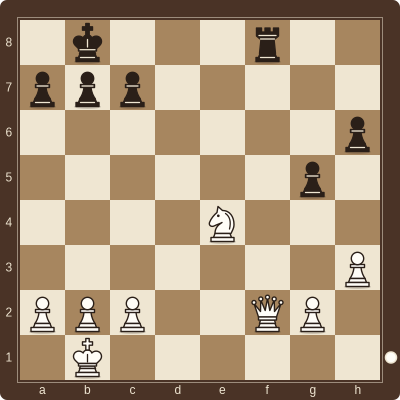
1k3r2/ppp5/7p/6p1/4N3/7P/PPP2QP1/1K6 w - - 0 1Compare it with the first diagram. The white king has moved across from g1 to b1, and the knight from d4 to e4. A simple anchor test catches this: choose a piece near an edge, name its square on both boards and make sure the letters agree.
- Half a turn. Copying a Black's-side picture as if it were White's reverses both files and ranks.
- Off by one. A whole block of pawns shifted by one square still looks tidy.
- Dark square on the right. Fix the board before placing anything.
- Skipping the turn. The same pieces can pose a completely different question.
- Look-alike symbols. In small print, compare bishops with pawns and queens with kings.
Before you start solving
- The orientation is confirmed from the labels.
- The side to move is known.
- The counts agree for both colors.
- Each square has been named a second time.
Common questions
Which side is at the bottom of a chess diagram?
Usually White. Check the edge letters and numbers, because some diagrams are drawn from Black's side.
How do I know whose turn it is in a diagram?
Look for a caption or a marker beside the board. If there is neither, read the text around the picture.
In what order should I set up a position?
Place the kings, then the other pieces by type, then the pawns file by file. Finish by counting both sides.
Why does my board give a different answer from the diagram?
Check the orientation, then the side to move, then each square. A mirrored or shifted copy can change the solution.
Sources
- FIDE Laws of Chess taking effect from 1 January 2023. International Chess Federation (FIDE) Handbook. Rules of movement (Article 3), end of the game (Article 5), recording moves (Article 8), drawn positions (Article 9) and algebraic notation (Appendix C). Consulted on 25 November 2026.