The player to move has nothing legal. The game is over. Whether it ends as a win or a draw depends on a single fact, and many beginners look at it too late.
By the end of this page you can name the three ways out of check, tell checkmate from stalemate at a glance, and spot the careless queen move that throws a won game away.
Check: the king is attacked
A king is in check when an enemy piece attacks the square it stands on. The player in check has to deal with it on this very move. No other plan comes first, however good it looks.
You may not make a move that leaves your own king attacked. That single rule explains almost everything below. It is why a king cannot step next to the other king, and why a piece that shields its king often cannot leave its post.
Any piece except a king can give check. A queen, rook or bishop does it along an open line, sometimes from the far side of the board. A knight does it with its L-shaped jump, and a pawn does it one square diagonally forward. Look at all of them, not only the piece that just moved: a move can open a line for a piece standing behind it.
The three ways out of check
- Move the king to a square that no enemy piece attacks.
- Block the line by putting a piece between the checker and the king. This works against a queen, rook or bishop checking from a distance. A knight jumps, and a piece next to the king leaves no square in between.
- Capture the piece that gives check. The king may do this itself if that piece is not protected.
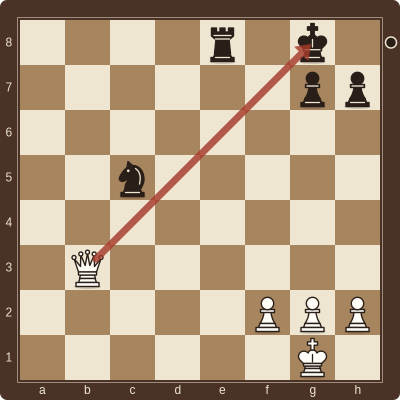
4r1k1/6pp/8/2n5/8/1Q6/5PPP/6K1 b - - 0 1| Reply | Way out of check |
|---|---|
| Kh8 | Move the king |
| Kf8 | Move the king |
| Re6 | Block with the rook |
| Ne6 | Block with the knight |
| Nxb3 | Capture the queen |
That is the whole list. Whether a reply is good is a separate matter, and taking the queen is clearly the one Black wants. When two pieces give check at once, only a king move can answer, as explained under double check.
Checkmate and stalemate side by side
Now take every option away. Checkmate means the player to move is in check and has no legal move. The game ends and the checking side wins. Stalemate means the player to move is not in check and has no legal move. The game ends as a draw.
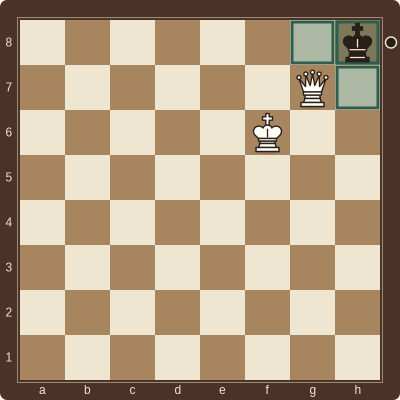
7k/6Q1/5K2/8/8/8/8/8 b - - 0 1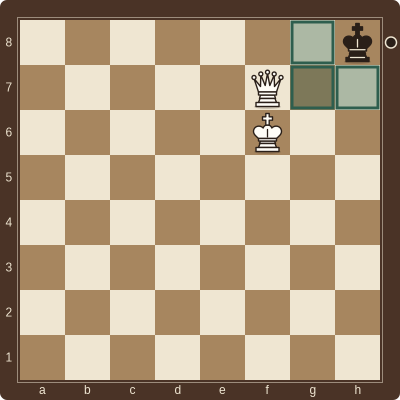
7k/5Q2/5K2/8/8/8/8/8 b - - 0 1One square of difference, opposite results. In the first picture the queen attacks h8 and the squares beside it, and the king cannot take the queen because the white king protects it. In the second the queen covers g8, g7 and h7 but leaves h8 itself alone. Black has no check to answer and no move to make.
| Question | Ordinary check | Checkmate | Stalemate |
|---|---|---|---|
| Is the king attacked? | Yes | Yes | No |
| Is there a legal move? | Yes | No | No |
| Result | Game goes on | Win for the attacker | Draw |
The one question to ask
When the side to move has nothing legal, ask only this: is that king in check right now? Yes means checkmate. No means stalemate. The size of the lead does not matter. A queen and two rooks against a bare king is still a draw if the king is stalemated.
Check the second half of the definition with equal care. A king with no safe square is not stalemated if any other piece on its side can still move. Pawns count too, even a pawn that looks useless.
Before a quiet move when you are far ahead
Spend a few seconds on your opponent's side of the board.
- Picture the board after your move, with your opponent to play.
- Find one legal move for them: the king first, then each piece and pawn.
- If there is none, confirm that your move gives check.
- If it gives no check, choose a different move.
How a big lead turns into a draw
Stalemate punishes the stronger side, often through a move that looks like progress. Here White has a queen and a rook against a lone king.
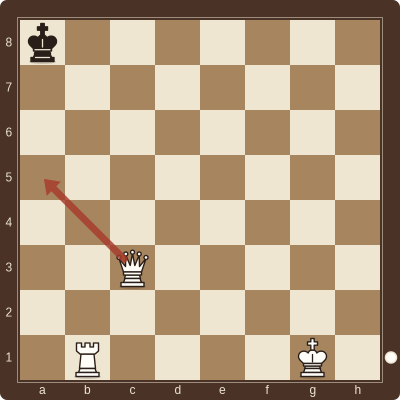
k7/8/8/8/8/2Q5/8/1R4K1 w - - 0 1Qa1#, Qa3# and Qa5# all check along the a-file while the rook holds the b-file. Qc7 looks even tighter. Queen and rook then cover a7, b7 and b8, but nothing attacks a8. Black cannot move, so the game is drawn.
Now give Black one pawn on h6. The same queen move is no longer stalemate, because the pawn can still advance.
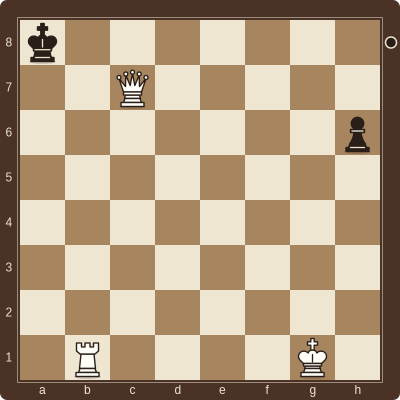
k7/2Q5/7p/8/8/8/8/1R4K1 b - - 0 1The only legal move is h5, and White then mates with Qb8#. Do not lean on a spare pawn, though. Once it is blocked or captured, the danger of stalemate is back.
Three habits protect a big lead. Leave the lone king at least one square until your mating move is ready. Look hardest at quiet moves that bring a queen close, because a queen takes away many squares at once. Before you promote a pawn, picture the new piece on the board and count the defender's replies.
Common mistakes
- Forgetting the king itself. You count the squares your pieces cover and never ask whether the king's own square is attacked.
- Stripping every defender. Capturing the last enemy pawn can remove the only move that kept the game alive.
- Calling stalemate a loss for the side that cannot move. It is a draw.
- Giving up too early. When you are far behind, look for a way to be left with no legal move while your king is not in check. This resource matters a lot in rook pawn endings.
- Announcing mate too soon. Run through all three escapes before you believe it.
Where to put this to work
The two basic mating techniques test this knowledge on almost every move: mate with king and queen and mate with king and rook. A pattern to learn early is the back rank mate, a check that leaves no flight square, no block and no capture.
You can also compose your own near misses. Place the pieces in the Board builder, set who moves, and save the position with a note: mate, stalemate or neither. The tool does not analyze positions, so the verdict is your job.
Common questions
Is stalemate a win or a draw?
A draw. Under the rules of chess neither player wins, however large the difference in pieces.
Can a king be checkmated without being in check?
No. Checkmate needs both a check and the lack of any legal reply. Without the check it is stalemate.
Can I castle to get out of check?
No. You may not castle while your king is in check. Move the king normally, block, or capture the checker.
Can a pinned piece block or capture to end a check?
Not if it is pinned to your own king. To block or capture the checker it would have to leave the line of the pin, which exposes your king.
Sources
- FIDE Laws of Chess taking effect from 1 January 2023. International Chess Federation (FIDE) Handbook. Rules of movement (Article 3), end of the game (Article 5), recording moves (Article 8), drawn positions (Article 9) and algebraic notation (Appendix C). Consulted on 25 November 2026.