In a double check two of your pieces attack the enemy king at the same moment. The side in check cannot solve both problems with a single block or a single capture, so only a king move is left.
Study the positions below and you will see how the second check appears, why normal defenses collapse, how double check can mate and when the king can still escape by taking a piece.
How the second check appears
One move can change only so much. To check twice, at least one of the checks has to be uncovered: a piece steps out of the way of a queen, rook or bishop and that line opens onto the king.
In the usual case the piece that moves also gives check itself from its new square. So the shape is the same as a discovered attack, with one extra condition: the front piece must land where it attacks the king too.
That tells you what to look for. First find a battery: one of your line pieces aimed at the enemy king with exactly one of your pieces in between. Then list every square the front piece can reach and mark those from which it would give check on its own. Each marked square that lies off the battery line is a double check.
The reason blocking and capturing fail is plain arithmetic. One reply can block one line or remove one attacker, and there are two separate attackers. Moving the king is different, because it can leave both lines at once.
| Way out | Single check | Double check |
|---|---|---|
| Move the king | Possible if a safe square exists | Possible if a safe square exists |
| Block the line | Possible against queen, rook or bishop | Not enough, the other check remains |
| Capture the checker with another piece | Possible if something reaches it | Not enough, the other check remains |
| King captures a checker | Possible if the square is then safe | Possible if the square is then safe |
A knight and rook double check
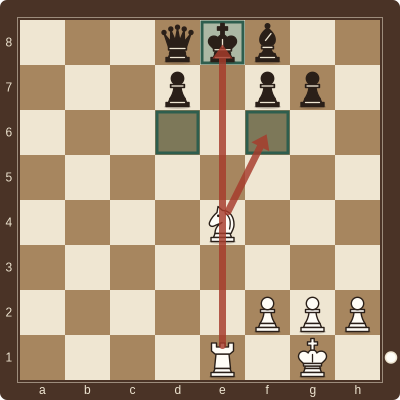
3qkb2/3p1pp1/8/8/4N3/8/5PPP/4R1K1 w - - 0 1Play Nf6#. The knight checks e8, and the rook checks it along the e-file. Black's pawn on g7 and queen on d8 both attack f6, yet neither may capture, since the rook check would remain.
The bishop could drop to e7 to shut the e-file, but the knight check would remain. So only the king may move, and it has nowhere to go: the queen, the bishop and two pawns fill its squares, and e7 lies on the rook's line. That is mate.
The jump Nd6# works for the same reason. Compare both with Nc5+, which uncovers the rook but does not give a second check. Now Black can simply block with Be7 or Qe7. Same pieces, one square different, a completely different result.
Rook and bishop working together
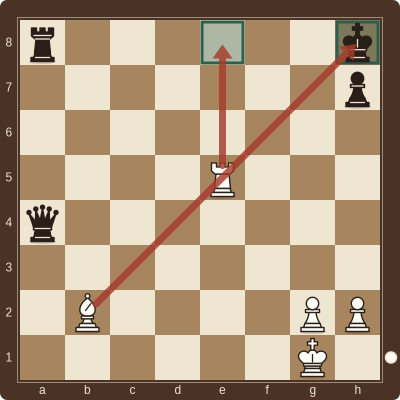
r6k/7p/8/4R3/q7/8/1B4PP/6K1 w - - 0 1White is far behind here, with a rook and bishop against a queen and rook. It does not matter. After Re8# the rook checks along the eighth rank and the bishop checks along the diagonal.
Both the rook on a8 and the queen on a4 attack e8. If either could capture, the bishop would still be giving check, so neither move is legal. The king cannot step to g8, which the new rook covers, or to g7, which the bishop covers, and its own pawn stands on h7.
Positions like this show why you should check for double checks even when your pieces look badly outmatched. The defender's extra material is simply not allowed to help.
When the king can capture
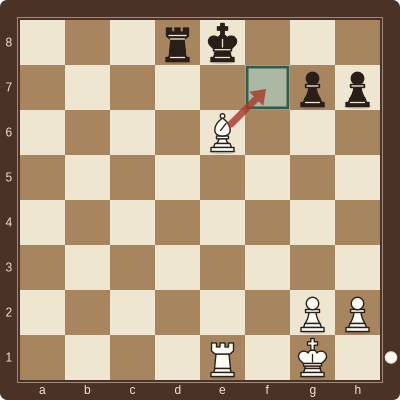
3rk3/6pp/4B3/8/8/8/6PP/4R1K1 w - - 0 1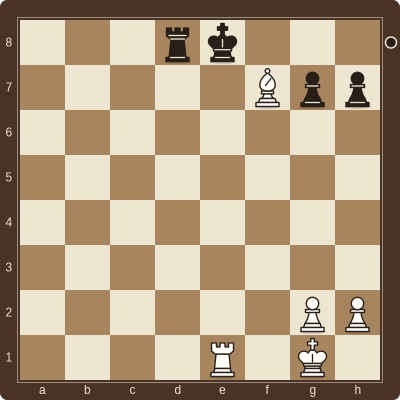
3rk3/5Bpp/8/8/8/8/6PP/4R1K1 b - - 1 1After Bf7+ the black rook on d8 has no legal move at all. The king, however, can play Kxf7. Taking the bishop removes one attacker, and the f7 square is not on the e-file, so the other check disappears too.
A capture can answer a double check only when the king itself makes it. The captured piece must be unprotected, and the king must end on a square that no enemy piece attacks. In this position White has simply given up a bishop.
So before you play a double check with a piece that touches the king, make sure something guards that square.
From the defending side, the same facts give you a short routine. Forget moves by your other pieces. Look only at your king and its neighboring squares. Stepping straight back along a checking line does not help, because the attacker then sees through the square you left. If one neighboring square holds an unprotected enemy piece, test that capture first.
Using double check in your games
A double check is about as forcing as a move can be. Because the reply list is so short, it is easy to calculate: list the king's squares and look at what you can do after each one.
It is also useful when it does not mate. The enemy king is pushed to one of a few squares, often away from its shelter, while every other piece on that side stands still for a turn. That can be the moment to bring up a new attacker.
Testing a double check
- Do both pieces really attack the king after the move?
- Can the king capture the piece that moved?
- Which neighboring squares are covered by the first checker?
- Which are covered by the second?
- If the king escapes, what is your next forcing move?
Double check also plays a part in the classic smothered mate sequence, and the Arabian and Anastasia mates call for the same careful look at the king's squares. If you are unsure whether the final position is really mate, read checkmate or stalemate.
Common double check mistakes
- Trying to block or capture when only the king may move.
- Assuming every double check is mate without counting the king's squares.
- Landing the front piece next to the king without a defender.
- Choosing a square that gives one check when another square gives two.
Set up each position with the Board builder and try to find a legal reply that is not a king move. Failing to find one is the fastest way to make the rule stick.
Common questions
Can you block a double check?
No. A block can close only one line, and the other attacker would still be giving check. Only a king move is legal.
Can the king capture a piece during double check?
Yes, if that piece is not protected and the king ends on a square no enemy piece attacks. The capture counts as a king move.
Is every double check a discovered check?
At least one of the two checks is uncovered by a move, so a double check always involves a discovery.
Is double check always checkmate?
No. If the king has a safe square, including a safe capture, the game goes on.
Sources
- FIDE Laws of Chess taking effect from 1 January 2023. International Chess Federation (FIDE) Handbook. Rules of movement (Article 3), end of the game (Article 5), recording moves (Article 8), drawn positions (Article 9) and algebraic notation (Appendix C). Consulted on 25 November 2026.