Being ahead can feel like the end of the work. It is really the start of a careful stretch, where one hasty exchange can hand your opponent a draw.
Here you will learn how to cut down the other side's chances while keeping your advantage: what to swap, what to keep and where the traps lie.
Swap pieces, keep pawns
A common guideline says that the side with more material should trade pieces and avoid trading pawns. Each pair of pieces that leaves takes some of the defender's counterattack with it, while your extra unit becomes a bigger share of what is left.
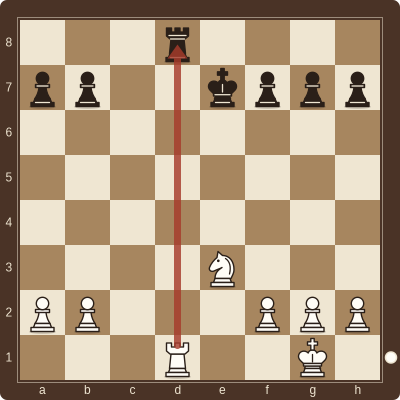
3r4/pp2kppp/8/8/8/4N3/PP3PPP/3R2K1 w - - 0 1After Rxd8 Kxd8 the knight has no enemy piece to fight it, and Black has no rook to attack your pawns or give checks. White has five pawns and an extra knight against five pawns, which is a comfortable position to play.
The point count, explained in piece points, tells you that you lead. The question of which swaps to accept comes after it.
Choose which pieces leave. The best candidates are the enemy pieces that attack your king, blockade your pawns or give checks. Keep the ones of yours that do the most, and let your quietest piece be the one you offer.
Keep at least one pawn alive
Extra pieces need a way to finish the game. A lone knight or bishop with a king cannot force mate, so your last pawn may be the whole difference between a win and a draw.
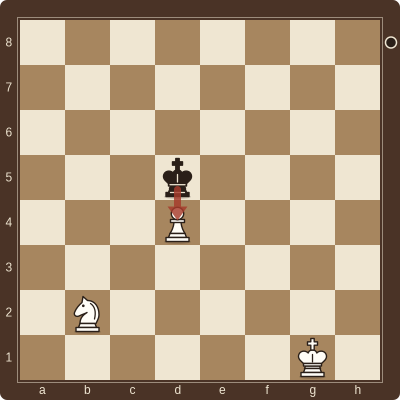
8/8/8/3k4/3P4/8/1N6/6K1 b - - 0 1Kxd4 leaves king and knight against king, and no sequence of legal moves can give mate. White needed to protect that pawn before the black king arrived. When you are ahead, count your remaining pawns as carefully as your pieces, and defend them first.
As a guideline, the side that is behind wants to trade pawns, and the side that is ahead wants to keep them. Watch for pawn exchanges that your opponent offers: they are rarely neutral.
Pawns on both wings are an extra help. The defender has to watch two places at once, and a lone king or minor piece struggles to do that. With every pawn on one side of the board, the same material lead can be much harder to convert.
Beware of opposite colored bishops
When each side has one bishop and they live on different colors, the defender can often block pawns on squares your bishop can never reach. Even two extra pawns may not be enough.
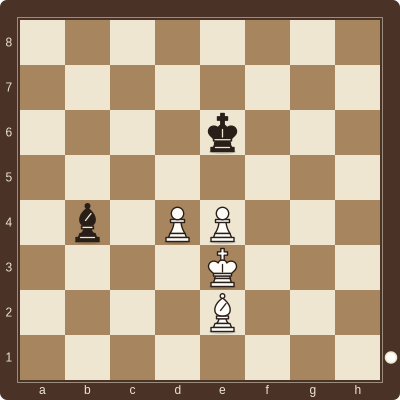
8/8/4k3/8/1b1PP3/4K3/4B3/8 w - - 0 1The white bishop runs on light squares and the black one on dark squares, so the two can never meet. With correct play Black holds. Before you exchange into such an ending, test it. With heavy pieces still on, opposite bishops can instead help the attacker, so this warning is about bare endings.
Put the extra material to work
Simplifying is not the goal, it is a way to make your advantage count. Once fewer pieces remain, bring your king toward the center, because most of the pieces that could trouble it are gone. Then look for a pawn majority, meaning more pawns than your opponent on one side, and use it to create a passed pawn.
Push the passer with support, not alone. A defender who must stop it with a piece or the king often leaves other pawns unguarded, and that is where your extra unit does the rest. If you cannot see progress, improve your worst placed piece and keep the pawns safe while you wait.
Watch for stalemate
With a big lead it is easy to take away every enemy move without giving check. That is stalemate, and it is a draw. Checkmate or stalemate shows how to tell them apart.
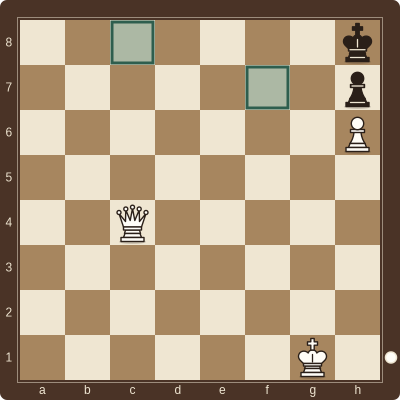
7k/7p/7P/8/2Q5/8/8/6K1 w - - 0 1Both moves look strong. Qf7 covers g8, g7 and h7 and leaves the king with nothing to do, while the black pawn is stuck. Qc8# gives check along the back rank. Before every quiet move near a bare king, ask whether your opponent will still have a legal reply.
Do not give back counterplay
A swap that looks simplifying can open lines for the other side. Before you capture, check which of their pieces gets a better square, whether their king becomes more active and whether a passed pawn is left that you cannot catch.
Sometimes the best answer to an offered exchange is no. If the swap would repair their weak pawns, free their king or give them an open file, you can keep the tension and ask for a better version of it later.
Queens deserve special care. With queens on, the weaker side may find repeated checks, called perpetual check, that end in a draw by repetition. Trading queens often removes that hope, as long as the ending that follows is still winnable.
If the swap would leave only kings and pawns, calculate it fully first, following trading into a pawn ending. For choosing exchanges when you are not ahead, see when to trade pieces.
A quick list for the side that is ahead
| Exchange | Usual advice | Check first |
|---|---|---|
| Their active pieces | Welcome it | No tactic against you |
| Queens | Often welcome | The ending still wins |
| Pawns | Avoid if possible | Enough pawns remain |
| Your last pawn | Avoid | Can you still force mate? |
| Into opposite bishops | Be wary | Can the pawns advance? |
Before you simplify
- Does this exchange reduce their threats?
- Do I keep a pawn that can still promote?
- Will they still have a legal move, or be mated?
- Do any of their passed pawns get free?
Common mistakes when ahead
- Trading every pawn. The pieces left may be unable to force mate.
- Moving fast because the win feels certain. The last moves still need checking.
- Leaving your opponent without a legal move and without check. The game is then drawn at once.
- Swapping into opposite bishops without testing it. Extra pawns may not break through.
- Forgetting their one dangerous pawn. Stop it first, then simplify.
To rehearse, save a won position from your own play in the Board builder, add a note with the swap you chose, and ask a partner to defend it as stubbornly as possible.
Common questions
Should you trade pieces when you are ahead?
Usually yes, as long as the exchange does not open counterplay or lead to a drawn ending.
Should I trade pawns when I am ahead?
Usually not many. Every pawn swap leaves fewer chances to promote, and some extra pieces cannot force mate alone.
Are opposite colored bishop endings always drawn?
No, but they often are, even with an extra pawn or two. Test the position before you choose to enter one.
How can I avoid stalemating my opponent?
Before each move, check that their side will still have a legal move, or that your move is checkmate.
Sources
- FIDE Laws of Chess taking effect from 1 January 2023. International Chess Federation (FIDE) Handbook. Rules of movement (Article 3), end of the game (Article 5), recording moves (Article 8), drawn positions (Article 9) and algebraic notation (Appendix C). Consulted on 25 November 2026.