Any exchange can be added up. A pawn counts 1, a knight or a bishop 3, a rook 5 and a queen 9. After this page you can run that sum through a chain of captures and say what it tells you.
These numbers are a long-standing habit among players, not part of the rules of chess. They help you avoid obvious losses of material. They do not know where your pieces stand.
The traditional point count
| Piece | Points | Keep in mind |
|---|---|---|
| Pawn | 1 | Grows in strength as it nears promotion |
| Knight | 3 | Short range, jumps over pieces |
| Bishop | 3 | Long range, stays on one color |
| Rook | 5 | Likes open files and ranks |
| Queen | 9 | Moves like a rook and a bishop |
| King | none | Cannot be captured, so it is never counted |
Add up what each side has on the board, or only what changes hands. The second way is quicker during a game: you need the pieces you win and the pieces you give back, nothing else.
Two common shortcuts follow from the table. Getting a rook in return for a knight or bishop is called winning the exchange, and it is a gain of two points. Giving up a knight for three pawns is level on paper, though the pawns may be strong or weak depending on how far they have advanced.
Think of every number as a comparison with one pawn. A knight counts as much as three pawns, a rook as much as five. The comparison is rough on purpose, so that you can do it in your head while the board is still in front of you.
Adding up a chain of captures
When several pieces aim at the same square, count the whole sequence before you start it. Write down who takes what, in order, and keep a running total. Stop at the point where each side would choose to stop.
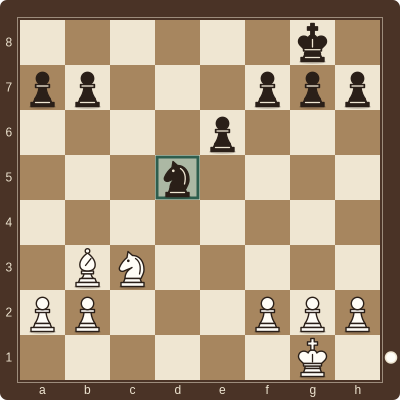
6k1/pp3ppp/4p3/3n4/8/1BN5/PP3PPP/6K1 w - - 0 1| Move | What is taken | Total for White |
|---|---|---|
| Nxd5 | Black knight, 3 | +3 |
| exd5 | White knight, 3 | 0 |
| Bxd5 | Black pawn, 1 | +1 |
The sequence has gained White one pawn, and nothing can take the bishop back. The routine behind the sum is simple: count attackers and defenders, then check the order, because the piece with fewer points usually should capture first.
Here that means the knight or bishop can start, since both count 3. With a rook and a pawn as attackers, you would normally lead with the pawn.
Worked sums for common exchanges
| You give | You receive | Your difference |
|---|---|---|
| Knight (3) | Bishop (3) | 0 |
| Rook (5) | Bishop and pawn (4) | -1 |
| Rook (5) | Knight (3) | -2 |
| Bishop and knight (6) | Rook and pawn (6) | 0 |
| Queen (9) | Two rooks (10) | +1 |
| Queen (9) | Rook and bishop (8) | -1 |
Read the last column as a first answer. A zero means the count has no opinion, so something else has to decide. A negative number is a warning: before you accept it, name what you get in return, such as a mating attack, a passed pawn that cannot be stopped or the escape of your king from danger.
A positive number is not a promise either. Check that your capturing piece can get away afterward, and that your own king stays safe when the sequence ends.
A rook against a bishop and a knight
A rook counts 5, while a bishop and a knight together count 6. On paper the two minor pieces lead by a point. A rook and a pawn make 6 as well, so that trade looks level.
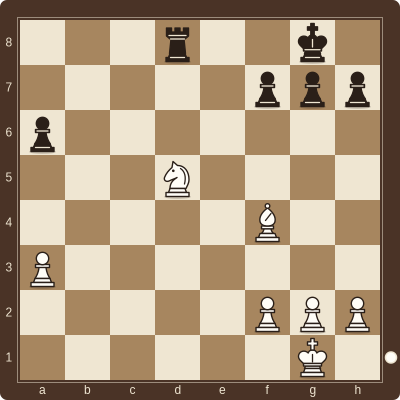
3r2k1/5ppp/p7/3N4/5B2/P7/5PPP/6K1 w - - 0 1The two minor pieces can both attack one square, here c7, which the black rook does not even cover. As a guideline, two minor pieces tend to do well while many pawns and pieces remain. A rook gains ground when files are open and the ending has passed pawns for it to escort or stop.
Two rooks against a queen
Two rooks count 10, one point more than a queen. The rooks are at their best when they protect each other and hit the same target. The queen is at its best when the rooks are scattered and the enemy king has little cover.
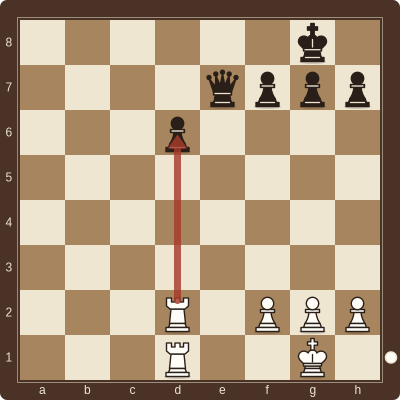
6k1/4qppp/3p4/8/8/8/3R1PPP/3R2K1 w - - 0 1The count here is level at 13 points each, since Black has one pawn more. Yet Rxd6 wins that pawn. If Black answers Qxd6, the second rook replies Rxd6 and Black has lost a queen and a pawn, 10 points, for one rook. So the queen has to let the pawn go.
When activity beats the numbers
The count treats every pawn as 1. A pawn two squares from promotion is far more dangerous than that, and two of them side by side can be more than a rook can handle.
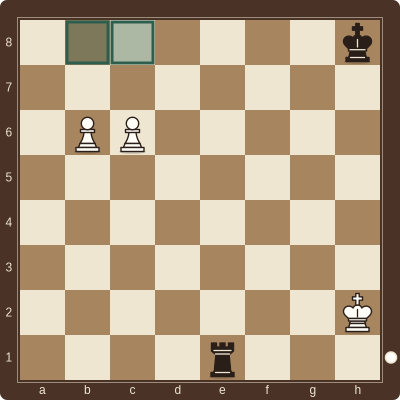
7k/8/1PP5/8/8/8/7K/4r3 w - - 0 1White plays b7 and the rook runs back with Rb1. Then c7 comes, and one rook cannot stop two runners. If it takes with Rxb7, the other pawn promotes by c8=Q+, with check. The black king is too far away to help.
The same thinking applies on a smaller scale. A knight in the middle of the board can be stronger than a rook shut in a corner, and a bishop that sees nothing may do less than a good pawn. Use the numbers to notice a loss, then look at the board to judge it.
Common mistakes with the count
- Stopping after the first capture. Follow the sequence until neither side wants to continue.
- Missing a hidden defender. A rook or queen can stand behind another piece on the same line.
- Reading a one-point edge as a win. It is a hint, and activity can easily outweigh it.
- Treating an advanced passed pawn like any other. Ask how many moves it needs to promote.
- Giving the king a number. It is never traded, though it can be a strong fighter in endings.
A quick routine for any exchange
Run this before you capture
- Count attackers and defenders of the square.
- Add up what each side loses, in order.
- Check for checks or threats that interrupt the sequence.
- Look at where the surviving pieces end up.
When the sum comes out level, the decision belongs to other questions: see when to trade pieces. For the most common level swap, see bishop or knight, and for two bishops of the same count that behave very differently, see good and bad bishops.
Once the sum favors you, simplifying when ahead explains how to keep the lead. To practice, rebuild a capture from your own game with the Board builder, write the total in the note and look at it again a week later.
Common questions
How many points is each chess piece?
Pawn 1, knight 3, bishop 3, rook 5 and queen 9 in the traditional count. The king has no number because it is never captured.
Is a rook stronger than a bishop and a knight?
On the count the two minor pieces lead by a point. In a real position it depends on open lines, passed pawns and king safety.
Are two rooks better than a queen?
The count gives the rooks a one-point edge. Rooks that support each other can win pawns, while a queen does well against an exposed king.
Do points decide who wins a game?
No. Games are decided by checkmate and the other rules of chess, never by the count. It is only a tool for judging material.
Sources
- FIDE Laws of Chess taking effect from 1 January 2023. International Chess Federation (FIDE) Handbook. Rules of movement (Article 3), end of the game (Article 5), recording moves (Article 8), drawn positions (Article 9) and algebraic notation (Appendix C). Consulted on 25 November 2026.