Sooner or later you write down a knight move and notice that either knight could have made it. A record like that cannot be replayed with confidence. The fix is small: one extra character, or in rare cases two.
You will learn the order in which to try them, how this works for knights, rooks and queens, where the character goes in a capture and why a pin can make it unnecessary.
The rule in three steps
The extra information goes straight after the piece letter and before everything else. Try these in order and stop at the first one that points to exactly one piece.
- Add the file the piece is leaving, if no other candidate stands on that file.
- Otherwise add its rank, if no other candidate stands on that rank.
- If one candidate shares the file and another shares the rank, add both, file first.
| Situation | Add | Sample |
|---|---|---|
| candidates on different files | file letter | Nbd2 |
| candidates on the same file | rank number | R1a3 |
| file and rank both shared | full starting square | Qc6e4 |
Add only what is needed. If a single piece can reach the square, there is nothing to add and the move stays short. The letters and numbers are the ordinary board coordinates. If the piece letters themselves are new to you, start with algebraic notation.
The fixed order has a practical use. Two people who record the same game will produce the same text, and a reader knows at once what an extra letter or number is there to tell.
Two knights and one square
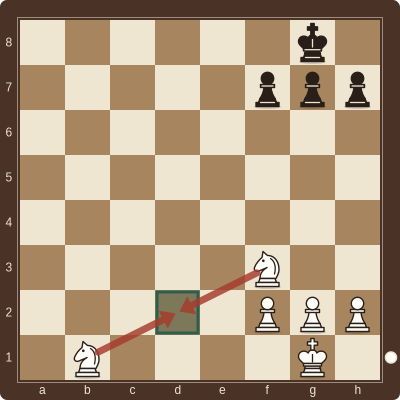
6k1/5ppp/8/8/8/5N2/5PPP/1N4K1 w - - 0 1The knights start on b1 and f3. Those are different files, so the file letter settles it. Nbd2 means the knight from the b-file and Nfd2 means the knight from the f-file. A bare move to d2 would leave the reader guessing.
Look at the destination before you add anything. Of these two, only the knight on b1 can reach c3, so that move is plain Nc3. The question is asked again for every move: the same pair of knights can need the letter for one square and not for another.
Which knight went matters later. After Nbd2 the other knight still sits on f3, while after Nfd2 the knight on b1 has not been touched. A difference of one letter leads to two different boards.
Rooks on a file or on a rank
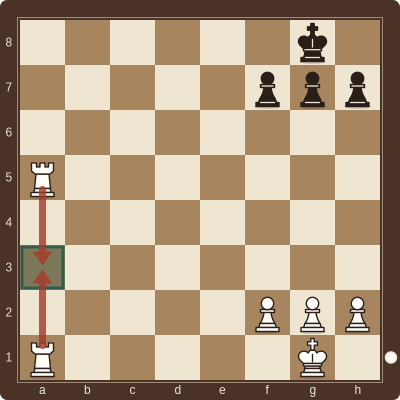
6k1/5ppp/8/R7/8/8/5PPP/R5K1 w - - 0 1Here a file letter would say nothing, because both rooks stand on that file. The rank number does the job. The move from a1 is R1a3 and the move from a5 is R5a3. The same pattern applies to the other empty squares between the two rooks.
When two rooks share a rank, you are back to the file letter. A capture keeps the same order: piece letter, extra character, then the x, then the square.
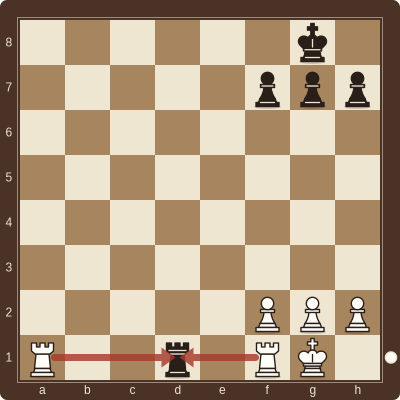
6k1/5ppp/8/8/8/8/5PPP/R2r1RK1 w - - 0 1The same diagram shows when to leave the letter out. Only the rook from a1 can go to b1, because the black rook stands between the other white rook and that square. The move is plain Rb1.
Check and mate signs are unaffected. They still go at the very end of the move, after the square.
Three queens and both coordinates
With only two candidates, one character is enough, because two different squares must differ in file or in rank. Both are needed only when at least three like pieces can reach the square. That takes at least one piece from pawn promotion, so you will meet it rarely. Queens make the clearest example.
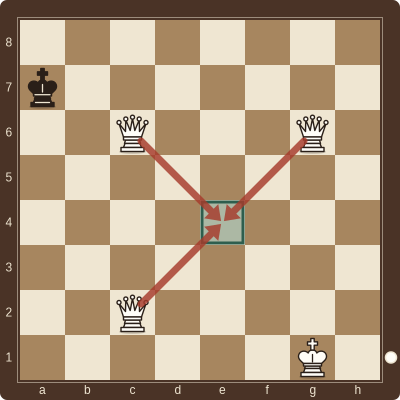
8/k7/2Q3Q1/8/8/8/2Q5/6K1 w - - 0 1| Queen leaving | Shares its file with | Shares its rank with | Written |
|---|---|---|---|
| c6 | the queen from c2 | the queen from g6 | Qc6e4 |
| c2 | the queen from c6 | no queen | Q2e4 |
| g6 | no queen | the queen from c6 | Qge4 |
The queen on c6 shares its file with one queen and its rank with another, so only its full square will do. The other two need a single character each, and not the same kind: a rank number for one and a file letter for the other.
Why pins can remove the ambiguity
Candidates are only the pieces that can legally make the move. A piece may not move if doing so would leave its own king in check. If one of two knights is held by an absolute pin, only the other can go, and you write the move with no extra character. The background is in pins in chess.
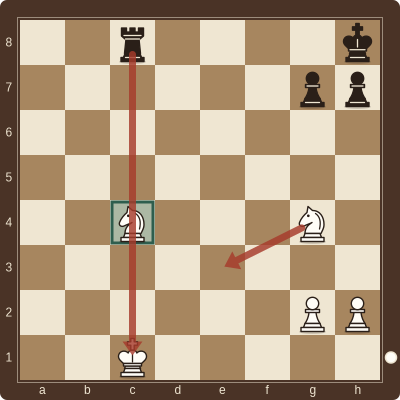
2r4k/6pp/8/8/2N3N1/8/6PP/2K5 w - - 0 1At first glance both knights point at e3. The rook on c8, however, looks through c4 at the white king on c1. The knight on c4 cannot move at all, so Ne3 can only mean the knight from g4.
A relative pin does not count. If moving a piece would only expose something other than the king, the move may be unwise, yet it is legal, so the extra character is still needed.
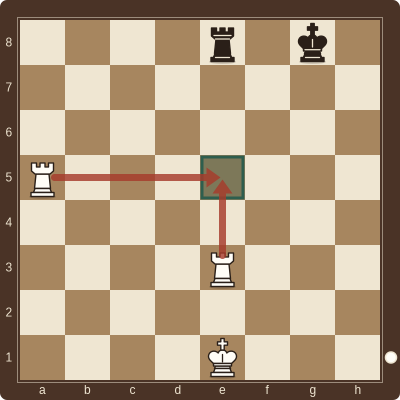
Be careful with rooks, bishops and queens. A pinned piece of this kind may be able to slide along the line of the pin. If it can reach the square that way, it still counts as a candidate.
4r1k1/8/8/R7/8/4R3/8/4K3 w - - 0 1Common mistakes with two like pieces
- Trying the rank first. The file letter is the first choice.
- Writing the full square out of habit. Nb1d2 is longer than needed when Nbd2 already names the knight.
- Counting a piece that cannot legally move. A piece pinned to its king may not leave the line of the pin.
- Counting a blocked piece. A rook with something in its path is not a candidate, even if it faces the square.
- Placing the character after the x. It goes before it, as in Raxd1.
- Applying the rule to pawn captures. They already begin with the file the pawn left.
Before you write the move
- List each piece of that type that could go to the square.
- Cross out any that are blocked or would leave their king in check.
- If one remains, write the move with no extra character.
- If more remain, try the file, then the rank, then both.
When you replay someone's record, run the same steps backwards. Find each piece of that type that could make the move, then keep the one that matches the extra letter or number.
For a doubtful case, set the position up in the Board builder and trace each candidate with your eye. The tool shows the pieces and does not suggest moves, so the judgment is yours.
Common questions
Which comes first, the file or the rank?
The file. Use the rank when the file does not identify the piece, and both only when neither is enough alone.
Do I need the extra letter if one of the pieces is pinned?
Not if the pin stops it from making that move. If it can still reach the square legally, you need it.
How do pawn captures show which pawn moved?
A pawn capture starts with the file the pawn left, such as exd5, so nothing more is needed.
Can two bishops cause the same problem?
Only if both travel on squares of the same color, which means at least one of them came from promotion.
Sources
- FIDE Laws of Chess taking effect from 1 January 2023. International Chess Federation (FIDE) Handbook. Rules of movement (Article 3), end of the game (Article 5), recording moves (Article 8), drawn positions (Article 9) and algebraic notation (Appendix C). Consulted on 25 November 2026.
- Portable Game Notation Specification and Implementation Guide. Coordinated by Steven J. Edwards. Standard algebraic notation (section 8.2.3) and the FEN position format (section 16.1). Consulted on 25 November 2026.