Your opponent takes something and your hand is already moving to take back. Stop. There may be a stronger move to make first, one that has to be answered before the recapture comes up again.
That inserted move is called an in-between move, or zwischenzug. After these four positions you should be able to find one of your own, see the opponent's coming and recognize when the idea fails.
What the in-between move is
Most exchanges are played as a pair: one side captures, the other captures back. The in-between move breaks the pair. Instead of recapturing at once, you play a check, a mate threat or an attack on something big. The opponent answers it, and only then do you complete the exchange, or do something better.
It works because a threat that is more urgent than the recapture has to be dealt with first. It fails when the answer to your threat also saves the piece you meant to take back.
| Inserted move | Why it must be answered | What to verify |
|---|---|---|
| Check | The king is attacked | Can the recapture still happen afterward? |
| Mate threat | Ignoring it ends the game | Does the defense also rescue their piece? |
| Attack on a queen or rook | Too much would be lost | Can that piece escape with check? |
A check that has to come first
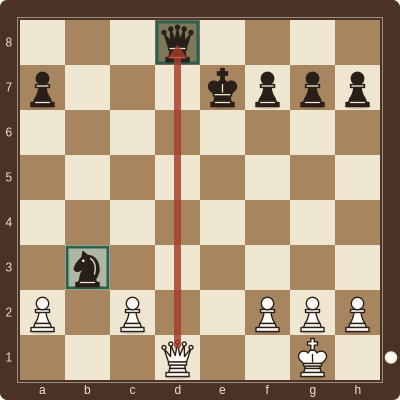
3q4/p3kppp/8/8/8/1n6/P1P2PPP/3Q2K1 w - - 0 1Black has just taken a piece on b3, and two pawns are ready to take back. Both are terrible: after axb3 or cxb3 comes Qxd1#. The queens are facing each other, and a pawn move gives Black the first shot.
The answer is Qxd8+ before anything else. The check must be met, normally by Kxd8, and then cxb3 collects the knight in peace. If Black prefers Ke6, White has simply taken the queen. Same recapture, one move later, and the position is completely different.
A threat bigger than the recapture
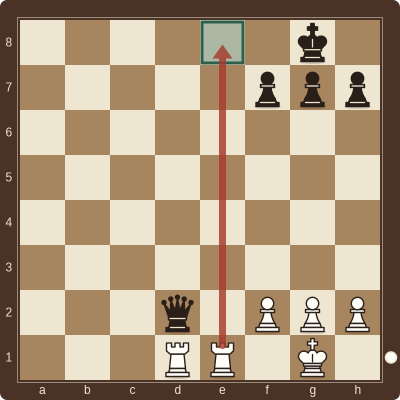
6k1/5ppp/8/8/8/8/3q1PPP/3RR1K1 w - - 0 1Black has just captured on d2, and Rxd2 looks automatic. It is even a good move. But Re8# is on the board, and a mate ends every argument about material.
This is the habit to build: when the opponent captures, do not look at the recapture first. Look at all your checks first, then at your threats, and only then at taking back.
A mate threat that is not yet mate works the same way. The other side has to spend its turn stopping it, so ask which of their defenses would also protect or move the piece you intend to take.
A check that collects extra material
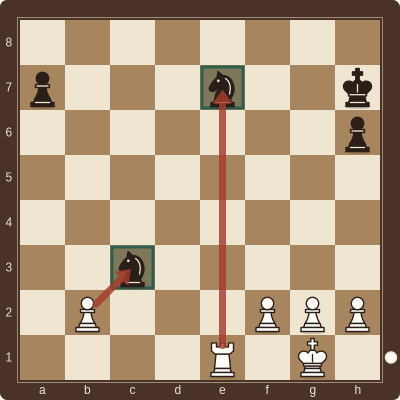
8/p3n2k/7p/8/8/2n5/1P3PPP/4R1K1 w - - 0 1Black has just taken on c3. If you answer bxc3 at once, Black has time for Ng6 and the second knight is safe.
Reverse it. Rxe7+ takes the loose knight with check. Black must move the king, and the knight on c3 has no way to help from there. Next, bxc3 is still available. You collect both knights instead of one.
The key detail is that the piece to be recaptured could not use Black's reply to escape. Check this every time: after your inserted move, which pieces can the opponent move?
When the in-between move fails
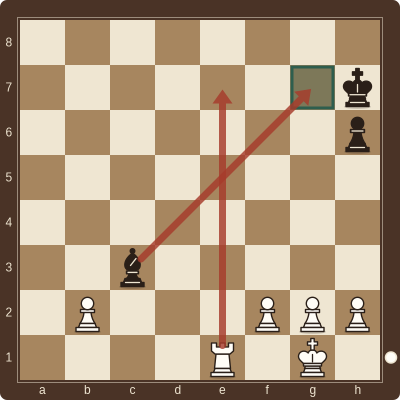
8/7k/7p/8/8/2b5/1P3PPP/4R1K1 w - - 0 1Here the black piece on c3 is a bishop, and it is attacking your rook. A check looks like a neat way to move the rook and take the bishop later. But Re7+ is met by Bg7: the bishop blocks the check and leaves c3 at the same time. The recapture is gone.
The right move is the plain bxc3. An in-between move is only better than the recapture if the recapture, or something larger, is still there afterward.
Compare this with the previous diagram. The shape is nearly the same, yet there the inserted move won an extra piece and here it lets one escape. The difference is that a bishop can travel back along its diagonal to block, while the knight on c3 could not reach the line of the check.
Looking for it from both sides
The idea cuts both ways. Before you start an exchange, imagine you have captured and ask what your opponent can do instead of taking back. Look closely at their checks, at your own unprotected pieces and at any weakness on your back rank.
Take the third diagram from the defender's chair. Before capturing on c3, Black needed to ask what White could do besides taking back. The answer was sitting in plain view: a loose knight on e7, a rook aimed up the open file and a king on a rank with nothing in between.
Both players can have such moves in the same position, one answering the other. When that happens, follow the forcing moves until neither side has a check or a serious threat left, and only then count what each of you holds.
Move-order checklist
- What is the expected recapture?
- Before it, which checks do I have, and which does my opponent have?
- Are there mate threats or loose queens and rooks on either side?
- After the inserted move, can the target escape, block or capture?
- Is the final count better than simply recapturing?
Apply the same list when you are deciding when to trade pieces, since every exchange offers the other side a chance to interrupt. A defender with two jobs, as in overloaded pieces, often loses one of them to an inserted check, and many in-between checks are also a fork.
Common in-between mistakes
- Recapturing by reflex without looking at checks.
- Inserting a check just because it exists, and letting the target slip away.
- Calculating only your own in-between moves and none of your opponent's.
- Stopping the count before the exchange is actually finished.
To train the habit, set up any exchange from your own play on the Board builder, with the side to move set to the one about to recapture. Write every check in the note before you decide. The tool does not suggest moves, so the search is all yours.
Common questions
What does zwischenzug mean?
It is the traditional name for an in-between move: a move inserted before an expected reply, usually a recapture.
Does an in-between move have to be a check?
No. A mate threat or an attack on a queen or rook can also be urgent enough. A check is simply the easiest to calculate.
Can the in-between move be a capture?
Yes. Taking an unprotected piece with check before you recapture is one of the strongest kinds, because the opponent must answer the check first.
How do I avoid falling for one?
Before every capture, assume your opponent will not take back and look for their most forcing alternative.
Sources
- FIDE Laws of Chess taking effect from 1 January 2023. International Chess Federation (FIDE) Handbook. Rules of movement (Article 3), end of the game (Article 5), recording moves (Article 8), drawn positions (Article 9) and algebraic notation (Appendix C). Consulted on 25 November 2026.